Welcome

Добро пожаловать к этому международному месту открытки изображения. Benvenuto a questo luogo internazionale della cartolina di immagine. Καλωσορίστε σε αυτήν την διεθνή περιοχή καρτών εικόνων. Willkommen zu diesem internationalen Abbildungspostkarteaufstellungsort. Bienvenue à cet emplacement international de carte postale. Onthaal aan deze Internationale plaats van de beeldprentbriefkaar. Welcome to this International picture postcard site. (Please Click on the Picture for an Enlarged View)

Saturday, July 21, 2012

Hannover - The Kröpcke Clock


Hanover or Hannover, on the river Leine, is the capital of the federal state of Lower Saxony (Niedersachsen), Germany and was once by personal union the family seat of the Hanoverian Kings of Great Britain, under their title as the dukes of Brunswick-Lüneburg (later described as the Elector of Hanover). At the end of the Napoleonic Wars, the Electorate was enlarged to become the capital of the Kingdom of Hanover.
In addition to being the capital of Lower Saxony, Hanover was the capital of the administrative area Regierungsbezirk Hannover (Hanover region) until Lower Saxony's administrative regions were disbanded at the beginning of 2005. Since 2001 it is part of the Hanover district (Region Hannover), which is a municipal body made up from the former district (Landkreis Hannover) and city of Hanover (note: although both Region and Landkreis are translated as district they are not the same).
With a population of 522,686 (31 December 2010) the city is a major centre of northern Germany, known for hosting annual commercial trade fairs such as the Hanover Fair and the CeBIT. Every year Hanover hosts the Schützenfest Hannover, the world's largest marksmen's festival, and the Oktoberfest Hannover, the second largest Oktoberfest in the world. In 2000, Hanover hosted the world fair Expo 2000. The Hanover fairground, due to numerous extensions, especially for the Expo 2000, is the largest in the world. Hanover is also of national importance because of its universities and medical school, its international airport, and its large zoo. The city is also a major crossing point of railway lines and highways (Autobahnen), connecting European main lines in east-west-direction (Berlin - Ruhr area) and north-south-direction (Hamburg - Munich et al.).
And, what you see on the card is the The Kröpcke Clock. Hannover's most famous meeting spot, located above the Kröpcke underground train station, the main station of City Center. This Kröpcke Clock is a 1977 replica of the original built by Konrad Oertel in 1885 but destroyed in WWII. It takes its name from Wilhelm Kröpcke, a famous headwaiter of a cafe in the area. The four corners have all the 12 Zodiac signs on them. This lovely card was sent to me by Sisela.

Friday, July 20, 2012

The Pentagon


The Pentagon is the headquarters of the United States Department of Defence, located in Arlington County, Virginia. As a symbol of the U.S. military, "the Pentagon" is often used metonymically to refer to the Department of Defence rather than the building itself.
Designed by the American architect George Bergstrom (1876–1955), and built by Philadelphia, Pennsylvania, general contractor John McShain, the building was dedicated on January 15, 1943, after ground was broken for construction on September 11, 1941. General Brehon Somervell provided the major motive power behind the project; Colonel Leslie Groves was responsible for overseeing the project for the Army.
The Pentagon is the world's largest office building by floor area, with about 6,500,000 sq ft (600,000 m2), of which 3,700,000 sq ft (340,000 m2) are used as offices. Approximately 28,000 military and civilian employees and about 3,000 non-defence support personnel work in the Pentagon. It has five sides, five floors above ground, two basement levels, and five ring corridors per floor with a total of 17.5 mi (28.2 km) of corridors. The Pentagon includes a five-acre (20,000 m2) central plaza, which is shaped like a pentagon and informally known as "ground zero", a nickname originating during the Cold War and based on the presumption that the Soviet Union would target one or more nuclear missiles at this central location in the outbreak of a nuclear war.
On September 11, 2001, exactly 60 years after the building's groundbreaking, hijacked American Airlines Flight 77—a Boeing 757-223—was crashed into the western side of the Pentagon, killing 189 people including five hijackers, 59 others aboard the plane, and 125 working in the building.
Thank you Pam for this card.

Thursday, July 19, 2012

Life at Sea


I really love this card showing young seamen washing the deck. They must have holy stoned it earlier of course.  It reminds me of my cadet days on the training ship. The only difference being that the petty officer overseeing our work always had a frown on his face and never seemed satisfied with our efforts J This cute card was sent to me by Sien.

Wednesday, July 18, 2012

Easy-Reading


This was the second of the "Easy-Reading" series, following on from the Bible theme of 6060a. In the inside front cover, these books point out that "even children whose reading experience is limited will be encouraged by the superb full-colour illustrations and the relatively simple text". And superb the illustrations were, created by John Berry approaching near photographic precision with a paintbrush.
The Soldier, in 1966, was the first in the series to be issued in the matt cover, dust-jacket-less format. Written by I & J Havenhand, illustrated by Berry, it is, as you might expect, full of tanks, guns, rockets and other exciting bits of machinery. Today’s high technology is not much in evidence; "all regiments of the army have radios in case the telephone wires get broken". The engineers have an especially exciting job; "radios, watches, telephones, rockets, tanks and helicopters are among the many things that the soldiers mend in their workshops". However, nowhere in the book does it mention that the ultimate job of the fighting soldier is to kill people. Yes Ira, I was thrilled to get your card, because, I had already read this book some time ago, and had thoroughly enjoyed it. In case you get a chance do read the other books in the series, the Sailor, the Airman et al.

Tuesday, July 17, 2012

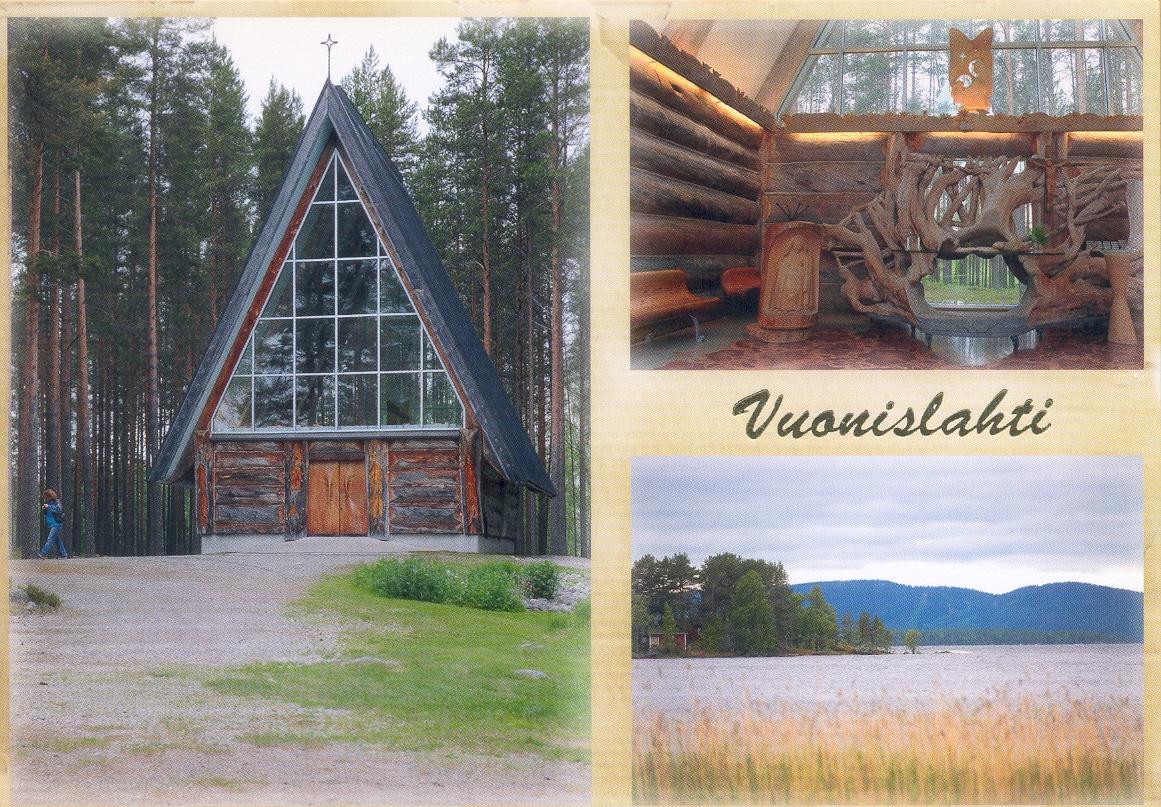
Eva Ryynänen


Eva Ryynänen, June 15, 1915  - 18 October 2001) was a Finnish sculptor. She used wood as her medium. Ryynänen studied with the Finnish Academy of Fine Arts School from 1934 to 1939. The artist's debut show was in 1940. She has made more than 500 sculptures, 50 of which are overseas. Ryynänen Vuonislahti studio is located 28 kilometers from Lieksa Joensuu. The studio, Ryynänen's house and the Paateri Church are in the same compound, and now, are popular tourist attractions. Ryynänen’s husband was a farmer, Paavo Ryynänen (d. 2002). Ryynänen’s parents were Juho Åsenbrygg (Honka Lake) and Aino Å., Os Hujanen. Merja gave me this nice card which show’s the chapel and Lake Pielinen.
The studio, home, gallery-café and chapel of the wood sculptress Eva Ryynänen are situated at Paateri, in the village of Vuonisjärvi, 30 km from the town centre of Lieksa towards Joensuu.  Her biggest single project, the unique Paateri chapel, was completed in the summer of 1991. Paateri has become one of the most popular tourist attractions in Lieksa.

Monday, July 16, 2012

Sauna Accessories


The wooden accessories are beautifully handcrafted of Finnish pine and Finnish craftsmanship. A bucket and dipper are essential Sauna accessories. A dipper or two of water splashed over hot Sauna stones creates vapor, that promotes perspiration to flush the pores. It also transforms the hot dry air into a comfortable moist atmosphere. Without the use of water, the bather cannot enjoy a truly authentic Sauna experience. Since the buckets are made of natural wood, which has a tendency to expand and contract in the heat of the Sauna, heavy duty bucket liner’s are recommended in order to prevent leakage. Occasionally one uses leafy, fragrant boughs of silver birch called vihta in West Finland and vasta in East Finland to gently beat oneself. This has a relaxing effect on the muscles and also helps in calming the effects of mosquito bites. This pretty card was sent to me by Raija.

Sunday, July 15, 2012

The Steamer "Island Queen"


In the 1880's, a farmer named James Parker lived a few miles east of Cincinnati, Ohio. He came to realize that his apple orchard, in a scenic spot on the riverbank, earned more money when he rented it out for church picnics and other excursions than it ever could by growing apples. So in 1886 he sold the land to a riverboat company, who opened it as "Ohio Grove, the Coney Island of the West."  An advertsing poster from that year boasted that the grounds were lighted by electricity, and proclaimed it "The Most Beautiful All-Day Summer Resort in America."  The steamboat company ran four round trips a day between Cincinnati and "Coney Island," as the park came to be known. The total price (in 1886) was 50 cents, including admission to the grounds AND round-trip steamboat transportation. Coney Island finally closed its gates in 1971, to be replaced by the more modern Kings Island amusement park the following season.
By 1905, the steamboat company had become The Coney Island Company. That year, they purchased the 12-year-old steamboat "Saint Joseph" from owners in Mississippi, had her re-fitted, and re-named her the "Island Queen." For seventeen years she ran the several daily round trips between the Cincinnati levee and Coney Island. There was entertainment on board the steamboat as well, for this is the "Island Queen" on which "Chimes - A Novelty Rag" by Homer Denney and "The Queen Rag - March and Two Step" by Floyd Willis were played on a daily basis.
As was the case with so many of the old wooden steamboats, she met her end by fire. The "Island Queen," along with the "Morning Star," the "Chris Greene," and the "Tacoma" all burned in a spectacular blaze at the Cincinnati levee in November, 1922.
This grand old boat was succeeded by a second "Island Queen," built in 1925 on a steel hull originally intended for the steamer "Louisville," which was never built. The second "Island Queen" continued in daily Coney Island service until 1947, when her fuel tanks exploded during refitting work in Pittsburgh, with the loss of nineteen lives. A near-twin to the second "Island Queen" is still afloat. Originally named the "Cincinnati," this boat was re-fitted and re-named, and made her debut as the "President" in 1934. Re-fitted once again in 1991 as a floating casino, the "President" is now moored at Davenport, Iowa. Thank you Jessica for this lovely card.