Welcome

Добро пожаловать к этому международному месту открытки изображения. Benvenuto a questo luogo internazionale della cartolina di immagine. Καλωσορίστε σε αυτήν την διεθνή περιοχή καρτών εικόνων. Willkommen zu diesem internationalen Abbildungspostkarteaufstellungsort. Bienvenue à cet emplacement international de carte postale. Onthaal aan deze Internationale plaats van de beeldprentbriefkaar. Welcome to this International picture postcard site. (Please Click on the Picture for an Enlarged View)
Showing posts with label Warships. Show all posts

Tuesday, September 29, 2015

The Aurora in St Petersburg

Aurora is a 1900 Russian protected cruiser, currently preserved as a museum ship in St. PetersburgAurora was one of three Pallada-class cruisers, built in St. Petersburg for service in the Pacific. All three ships of this class served during theRusso-Japanese WarAurora survived the Battle of Tsushima and was interned under US protection in the Philippines, eventually returned to the Baltic Fleet. The second ship, Pallada, was sunk by the Japanese at Port Arthur in 1904. The third ship, Diana, was interned in Saigon after the Battle of the Yellow Sea. One of the first incidents of the October Revolution in Russia took place on the cruiserAurora.

Thank you Merja.

Monday, May 04, 2015

Brig "Mercury" Attacked by Two Turkish Ships


This wonderful card was sent to me by Mikhail Timona from the Republic of Mordovia.
Brig "Mercury" Attacked by Two Turkish Ships is an 1892 oil on canvas painting by Russian painter Ivan Aivazovsky (1817–1900). Aivazovsky painted over 6,000 works, more than half of which are seascapes.

It depicts three ships in close combat on a rough sea; as the name suggests, the battle occurs between two Turkish warships, and another ship referred to in the painting's title as the Russian brig Mercury. While Aivazovsky painted many seascapes, often involving ships and boats of various descriptions, and many showing ships that were damaged or shipwrecked, few of his works featured ships in close naval combat.

The battle portrayed was part of the Russo-Turkish War of 1828-29, a war sparked by the Greeks' struggle for independence and ensuing events. The Turkish Sultan became hostile to the Russians due their participation in the Battle of Navarino and, as a result, proceeded to close the Dardanelles for Russian ships and revoked the 1826 Convention of Akkerman.

After the conflict had ended, one of the navigators of the Turkish ships made a comment commending theMercury for her seaworthiness, and the captain for his bravery:
If in the great deeds of ancient or our times there are the feats of bravery, so this act put the others in the shade and the name of a hero should be wrote by the gold letter in the shrine of glory: the captain wasKazarsky, and the name of this brig was “Mercury”

Wednesday, December 03, 2014

Rostislav, a Russian Battleship

Irina of Saint Petersburg sent me this nice card showing ‘cleanship’ being carried out on the Rostislav, a Russian Battleship of the early ‘90s.
Rostislav was a pre-dreadnought battleship built by the Nikolaev Admiralty Shipyard in the 1890s for the Black Sea Fleet of the Imperial Russian Navy. She was conceived as a small, inexpensive coastal defence ship, but the Navy abandoned the concept in favor of a compact, seagoing battleship with a displacement of 8,880 long tons (9,020 t). Poor design and construction practices increased her actual displacement by more than 1,600 long tons (1,600 t). Rostislav became the world's first capital ship to burn fuel oil, rather than coal. Her combat ability was compromised by the use of 10-inch (254 mm) main guns instead of the de facto Russian standard of 12 inches (305 mm).

Her hull was launched in September 1896, but non-delivery of the ship's main guns delayed her maiden voyage until 1899 and her completion until 1900. In May 1899 Rostislav became the first ship of the Imperial Navy to be commanded by a member of the House of Romanov, Captain Alexander Mikhailovich. From 1903 to 1912 the ship was the flagship of the second-in-command of the Black Sea Fleet. During the 1905 Russian Revolution her crew was on the verge of mutiny, but ultimately remained loyal to the regime, and actively suppressed the mutiny of the cruiser Ochakov.

Rostislav was actively engaged in World War I until the collapse of the Black Sea Fleet in the beginning of 1918. She was the first Russian ship to fire on enemy targets on land during World War I, the first to be hit by a German airstrike, and the first to destroy a submarine, albeit a Russian one. In April 1918 the fleeing Bolsheviks abandoned Rostislav in Sevastopol. A year later the British occupation forces permanently disabled her engines. The White forces used the ship as a towed floating battery, then scuttled her in the Strait of Kerch in November 1920.

Saturday, May 03, 2014

Battleship Missouri Memorial

With the collapse of the Soviet Union in the early 1990s and the absence of a perceived threat to the United States came drastic cuts in the defense budget, and the high cost of maintaining and operating battleships as part of the United States Navy's active fleet became uneconomical; as a result, Missouri was decommissioned on 31 March 1992 at Long Beach, California. Her last commanding officer, Captain Albert L. Kaiss, wrote in the ship's final Plan of the Day:
Our final day has arrived. Today the final chapter in battleship Missouri’s history will be written. It's often said that the crew makes the command. There is no truer statement ... for it's the crew of this great ship that made this a great command. You are a special breed of sailors and Marines and I am proud to have served with each and every one of you. To you who have made the painful journey of putting this great lady to sleep, I thank you. For you have had the toughest job. To put away a ship that has become as much a part of you as you are to her is a sad ending to a great tour. But take solace in this—you have lived up to the history of the ship and those who sailed her before us. We took her to war, performed magnificently and added another chapter in her history, standing side by side our forerunners in true naval tradition. God bless you all.
—Captain Albert L. Kaiss
Missouri returned to be part of the reserve fleet at Puget Sound Naval Shipyard, Bremerton, Washington, until 12 January 1995, when she was struck from the Naval Vessel Register. She remained in Bremerton, but was not open to tourists as she had been from 1957 to 1984. In spite of attempts by citizens' groups to keep her in Bremerton and be re-opened as a tourist site, the U.S. Navy wanted to pair a symbol of the end of World War II with one representing its beginning. On 4 May 1998, Secretary of the Navy John H. Dalton signed the donation contract that transferred her to the nonprofit USS Missouri Memorial Association (MMA) of Honolulu, Hawaii. She was towed from Bremerton on 23 May to Astoria, Oregon, where she sat in fresh water at the mouth of the Columbia River to kill and drop the saltwater barnacles and sea grasses that had grown on her hull in Bremerton, then towed across the eastern Pacific, and docked at Ford Island, Pearl Harbour on 22 June, just 500 yd (460 m) from the Arizona Memorial. Less than a year later, on 29 January 1999, Missouri was opened as a museum operated by the MMA.
Thank you Becky for this lovely card.


Friday, May 02, 2014

The National Memorial Cemetery of the Pacific


The National Memorial Cemetery of the Pacific (informally known as Punchbowl Cemetery) is a national cemetery located at Punchbowl Crater in Honolulu, Hawaii. It serves as a memorial to honor those men and women who served in the United States Armed Forces, and those who have given their lives in doing so. It is administered by the National Cemetery Administration of the United States Department of Veterans Affairs and is listed on the National Register of Historic Places. Millions of visitors visit the cemetery each year, and it is one of the most popular tourist attractions in Hawaii.


This lovely card was sent by Becky.

Thursday, May 01, 2014

USS Arizona Memorial

My friend Becky from Hawaii sent me these nice cards of the Arizona Memorial.
The USS Arizona Memorial, located at Pearl Harbour in Honolulu, Hawaii, marks the resting place of 1,102 of the 1,177 sailors and Marines killed on the USS Arizona during the attack on Pearl Harbour on 7 December 1941 by Japanese imperial forces and commemorates the events of that day. The attack on Pearl Harbor and the island of Oʻahu was the action that led to the United States' direct involvement in World War II.
The memorial, built in 1962, is visited by more than one million people annually.[1] Accessible only by boat, it straddles the sunken hull of the battleship without touching it. Historical information about the attack, shuttle boats to and from the memorial, and general visitor services are available at the associated USS Arizona Memorial Visitor Center, which opened in 1980 and is operated by the National Park Service. The sunken remains of the battleship were declared a National Historic Landmark on 5 May 1989.

Sunday, September 22, 2013

USS Lexington - The Blue Ghost

USS Lexington (CV/CVA/CVS/CVT/AVT-16), nicknamed "The Blue Ghost", is an Essex-class aircraft carrier built during World War II for the United States Navy. Originally intended to be named Cabot, word arrived during construction that the USS Lexington (CV-2) had been lost in the Battle of the Coral Sea. She was renamed while under construction to commemorate the earlier ship. This ship was the fifth US Navy ship to bear the name in honour of the Revolutionary War Battle of Lexington.
Lexington was commissioned in February 1943 and saw extensive service through the Pacific War. For much of her service she acted as the flagship for Admiral Marc Mitscher, and led the Fast Carrier Task Force through their battles across the Pacific. She was the recipient of 11 battle stars and the Presidential Unit Citation. Following the war Lexington was decommissioned, but was modernized and reactivated in the early 1950s, being reclassified as an attack carrier (CVA). Later she was reclassified as an antisubmarine carrier (CVS). In her second career, she operated both in the Atlantic/Mediterranean and the Pacific, but spent most of her time, nearly 30 years, on the east coast as a training carrier (CVT).
Lexington was decommissioned in 1991, with an active service life longer than any other Essex-class ship. Following her decommissioning she was donated for use as a museum ship in Corpus Christi, TexasIn 2003, Lexington was designated a National Historic Landmark. Though her surviving sisterships YorktownIntrepid, and Hornet carry lower hull numbers, Lexington was laid down and commissioned earlier, making Lexington the oldest remaining aircraft carrier in the world.
Thank you my friend Barbara for this fine card.

Sunday, March 17, 2013

USS Missouri Memorial


USS Missouri (BB-63) ("Mighty Mo" or "Big Mo") is a United States Navy Iowa-class battleship and was the third ship of the U.S. Navy to be named in honour of the US state of Missouri. Missouri was the last battleship built by the United States and was the site of the surrender of the Empire of Japan which ended World War II.
Missouri was ordered in 1940 and commissioned in June 1944. In the Pacific Theatre of World War II she fought in the battles of Iwo Jima and Okinawa and shelled the Japanese home islands, and she fought in the Korean War from 1950 to 1953. She was decommissioned in 1955 into the United States Navy reserve fleets (the "Mothball Fleet"), but reactivated and modernized in 1984 as part of the 600-ship Navy plan, and provided fire support during Operation Desert Storm in January/February 1991.
Missouri received a total of 11 battle stars for service in World War II, Korea, and the Persian Gulf, and was finally decommissioned on 31 March 1992, but remained on the Naval Vessel Register until her name was struck in January 1995. In 1998, she was donated to the USS Missouri Memorial Association and became a museum ship at Pearl Harbour, Hawaii. 

Thank you Duncan for this wonderful card.


Wednesday, October 10, 2012

Old Ironsides - USS Constitution


USS Constitution is a wooden-hulled, three-masted heavy frigate of the United States Navy. Named by President George Washington after the Constitution of the United States of America, she is the world's oldest commissioned naval vessel afloat. Launched in 1797, Constitution was one of six original frigates authorized for construction by the Naval Act of 1794 and the third constructed. Built in Boston, Massachusetts, at Edmund Hartt's shipyard, her first duties with the newly formed United States Navy were to provide protection for American merchant shipping during theQuasi-War with France and to defeat the Barbary pirates in the First Barbary War.
Constitution is most famous for her actions during the War of 1812 against Great Britain, when she captured numerous merchant ships and defeated five British warships: HMS GuerriereJava, PictouCyane and Levant. The battle with Guerriere earned her the nickname of "Old Ironsides" and public adoration that has repeatedly saved her from scrapping. She continued to actively serve the nation as flagship in the Mediterranean and African squadrons, and circled the world in the 1840s. Retired from active service in 1881, she served as a receiving ship until designated a museum ship in 1907 and in 1934 she completed a three-year, 90-port tour of the nation. Constitution sailed under her own power for her 200th birthday in 1997, and again in August 2012, to commemorate the 200th anniversary of her victory over Guerriere.
Constitution's stated mission today is to promote understanding of the Navy’s role in war and peace through educational outreach, historic demonstration, and active participation in public events. As a fully commissioned US Navy ship, her crew of 60 officers and sailors participate in ceremonies, educational programs, and special events while keeping the ship open to visitors year round and providing free tours. The officers and crew are all active-duty US Navy personnel and the assignment is considered special duty in the Navy. Traditionally, command of the vessel is assigned to a Navy Commander. She is berthed at Pier 1 of the former Charlestown Navy Yard, at one end of Boston's Freedom Trail. Thank you Charli for this lovely card.

Thursday, August 16, 2012

HNLMS Karel Doorman (R81)


Hr.Ms. Karel Doorman (R81) was a Colossus-class aircraft carrier of the Royal Navy of the Netherlands. Formerly the British ship HMS Venerable, she was sold to the Netherlands in 1948 as a light attack carrier. In 1960, she was involved in the decolonisation conflict in Western New Guinea with Indonesia. In the mid 60's the role was changed to anti-submarine warfare carrier and only ASW aircraft and helicopters were carried. An engine room fire took her out of service in 1968. She was sold to Argentina in 1969 and renamed ARA Veinticinco de Mayo. Zwollywood from Zwolle sent me this card.
The people of Zwolle are nicknamed Bluefingers. During the middle Ages the cities of Zwolle and nearby Kampen made life as difficult as possible for each other. The inhabitants of the latter city were named Kampen Sturgeons. The nickname Bluefinger was given to the Zwolle people because they supposedly committed perjury against the Duke of Gelre.
Some time later, another explanation was given. When Zwolle offered its glockenspiel from the Grote Kerk (St Michael’s Church) for sale, Kampen agreed to buy it and arrived with a wagon full of pennies. The citizens of Zwolle had to count a huge amount of copper coins and so earned their blue fingers. In 2007 the name Bluefinger surfaced across the Atlantic, as the title of a CD by Black Francis, a former member of the American band The Pixies. The source of inspiration for this CD is the late well-known musician and painter Herman Brood, who was born and lived in Zwolle.

Friday, August 03, 2012

Republic of China Navy


Not to be confused with People's Liberation Army Navy (PLAN), the naval forces of the People's Republic of China (PRC).
The Republic of China Navy is the maritime branch of the Armed forces of the Republic of China (Taiwan). The ROC Navy's primary mission is to defend ROC territories and the sea lanes that surround Taiwan against a blockade, attack, or possible invasion by forces of the People's Republic of China. Operations include maritime patrols in the Taiwan Strait and surrounding waters, as well as counter-strike and counter-invasion operations during wartime. The Republic of China Marine Corps functions as a branch of the Navy. The ship prefix for ROCN combatants is ROCS (Republic of China Ship); an older usage is CNS (Chinese Navy Ship).
This nice card showing three of ROC Navy’s ships alongside was sent to me by YuLing.

Tuesday, July 24, 2012

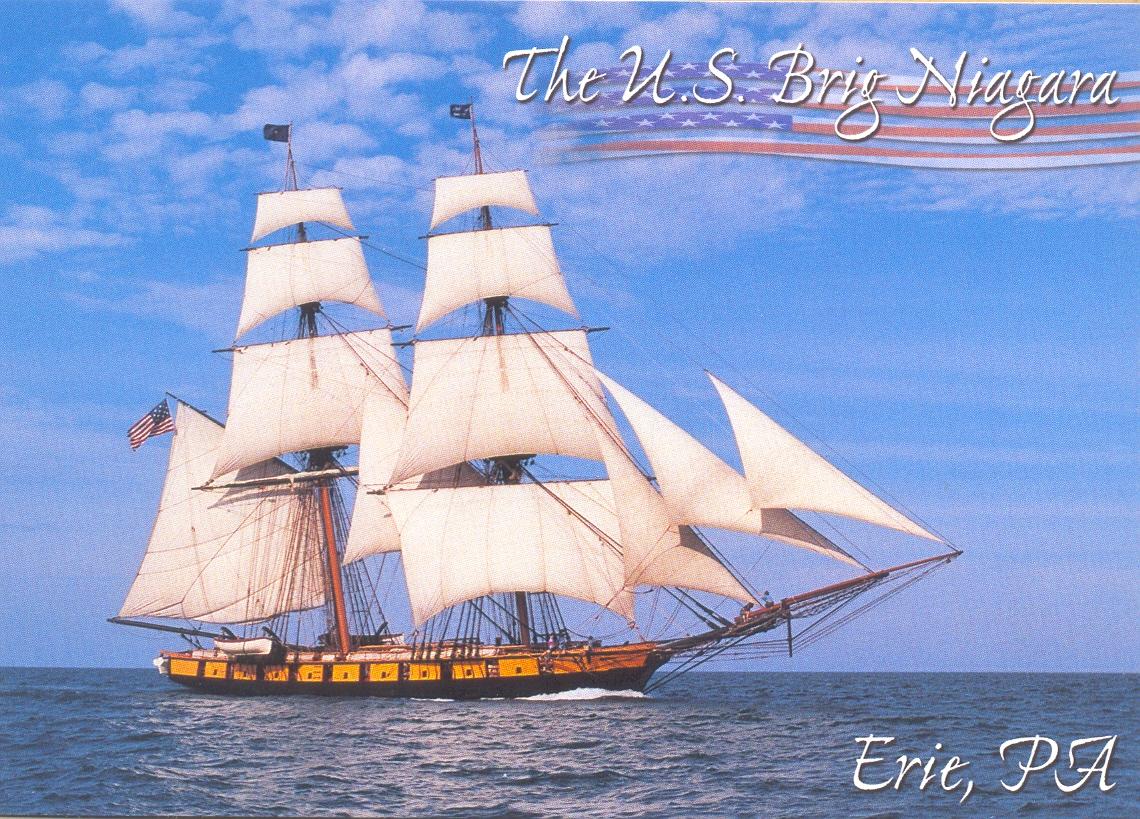
US Brig Niagara


US Brig Niagara or the Flagship Niagara, is a wooden-hulled brig that served as the relief flagship for Oliver Hazard Perry in the Battle of Lake Erie during the War of 1812. It is one of last remaining ships from the War of 1812. The Niagara is usually docked behind the Erie Maritime Museum in downtown Erie in the U.S. state of Pennsylvania as an outdoor exhibit for the museum, but travels the Great Lakes during the summer, serving as an ambassador of Pennsylvania when not docked. It was listed on the National Register of Historic Places in 1973 and was designated the official state ship of Pennsylvania by the Pennsylvania General Assembly in 1988. This lovely card was sent to me by Maria.

Tuesday, May 22, 2012

East Sea Ships


Latvia is a European state, which is situated on the coast of Baltic Sea. One of the three Baltic states, Latvia is bordered by Estonia to the north, Lithuania to the south, Russia to the east, Belarus on the south east, and the Baltic Sea on the west. The most famous travel spot is the capital Riga, a World Heritage Site. There are also many other great places to see, both urban and rural, such as Liepaja with its unique former secret military town of Karosta and a magnificent beach. Kuldiga with Europe’s widest waterfall and Cesis with its medieval castle ruins are also interesting. Tourists can also enjoy the wild beauty of Latvia's unspoilt seacoast, which is 500 km long and consists mainly of white, soft sandy beaches. Forests, which cover approximately a half of Latvia's territory, offer many nature trails and nature parks.

The stamp on this maxi card is one of a set of three which formed a set which was a Joint issue between Latvia and Lithuania Post, and was issued on May 10, 1997. My friend Merja sent me this extremely pretty maxi card. The ship shown on the card Battle-ship Das Wappen der Herzogin von Kurland (17th century). Shipbuilding flourished in the former Duchy of Kurland in present-day Latvia under Duke Jacob (1642-82). Ships were built at the Ventspils and Kuldiga shipyards, at first by German and Dutch, craftsmen invited by Duke Jacob, and later by local shipwrights. During Duke Jacob’s rule ships of all kinds of ships were built in Kurland, and not only for local needs but also for England, France, Spain and other countries. The biggest battle-ship built for Kurland itself, Das Wappen der Herzogin van Kurland was a four-decked three master armed with 72 naval guns and capable of holding 400 sailors and 100 soldiers. The ship was modelled after the English battleship Sovereign of the Seas.

Tuesday, April 03, 2012

HMS Victory


The most famous ship in the history of the Royal Navy, HMS Victory was Vice Admiral Horatio Nelson’s flagship at the Battle of Trafalgar in 1805. Victory was a First Rate, the most powerful type of ship of her day with three guns decks mounting 100 guns. Today she is docked at Portsmouth and as flagship of the Second Sea Lord and Commander-in-Chief Naval Home Command is the oldest warship in the world.

This lovely plastic embossed card was sent to me by my friend Ella.

Saturday, May 14, 2011

Russia – Cruiser Aurora

Aurora is a 1900 Russian protected cruiser, currently preserved as a museum ship in St. Petersburg. She battled the Japanese Navy in the Russo-Japanese War. One of the first incidents of the Communist Revolution in Russia took place on the cruiser Aurora. During the First World War the ship operated in the Baltic Sea. In 1915 her armament was changed to fourteen 152 mm (6 in) guns. At the end of 1916, the ship was moved to Saint Petersburg (later Petrograd) for a major repair. The city was brimming with revolutionary ferment and part of her crew joined the 1917 February Revolution. A revolutionary committee was created on the ship (Aleksandr Belyshev was elected its captain). Most of the crew joined the Bolsheviks, who were preparing for a Communist revolution.
On 25 October 1917, Aurora refused to carry out an order to put to sea, which sparked the October Revolution. At 9.45 p.m. on that date, a blank shot from her forecastle gun signalled the start of the assault on the Winter Palace, which was to be the last episode of the October Revolution. The cruiser's crew actually took part in the attack. Oxana sent me this card.

Tuesday, March 16, 2010

UK - HMS Alacrity

Dorothy sent me this nice card.

Wednesday, February 10, 2010

USA - USS KIDD (DD-661)

A national historic landmark, the USS Kidd is a restored WWII destroyer, one of the last ships of her era. USS KIDD (DD-661) is a Fletcher-class destroyer, the six hundred sixty-first destroyer built by the United States Navy. In the traditional system of naming destroyers after Naval heroes, she was named after Rear Admiral Isaac Campbell Kidd, Sr. who was killed aboard his flagship, USS ARIZONA (BB-39) during the surprise attack by the Japanese on the American fleet anchored at Pearl Harbor on December 7, 1941.
Commissioned into service on April 23. The KIDD's first voyage was one of some notoriety. Under the command of Cdr. Allan B. Roby, the destroyer moved across New York Harbor for delivery to the Brooklyn Naval Shipyards . . . flying the skull and crossbones of the Jolly Roger high from the foremast. The edition of TIME magazine that week carried a photo of KIDD, announcing that it had been one hundred years since the Jolly Roger had flown in New York Harbor. The crew quickly adopted the pirate Captain Kidd—who ironically hailed from New York—as their mascot and hired a local cartoonist to paint the famed buccaneer's image high of the forward smokestack. Not wishing to dishonor RADM Kidd, however, the crew obtained permission from Mrs. Kidd first. The Admiral's nickname at the Naval Academy had been "Cap" (as in "Captain Kidd") and he had gone by this nickname his entire life. So on the crew's behalf, Mrs. Kidd obtained official permission from the powers-that-be in the Navy for them to paint the pirate on the stack and fly the Jolly Roger. The KIDD would become the only vessel in the history of the United States Navy to ever have such leave granted to fly the flag of piracy.

Tuesday, January 19, 2010

France – Toulon


Toulon is a city in southern France and a large military harbour on the Mediterranean coast, with a major French naval base. Located in the Provence-Alpes-Côte-d'Azur region, Toulon is the capital of the Var department in the former province of Provence.
Toulon is an important centre for naval construction, fishing, wine making, and the manufacture of aeronautical equipment, armaments, maps, paper, tobacco, printing, shoes, and electronic equipment.
The military port of Toulon is the major naval centre on France's Mediterranean coast, home of the French Navy aircraft carrier Charles De Gaulle and her battle group. The French Mediterranean Fleet is based in Toulon.
The Toulon harbour is one of the best natural anchorages on the Mediterranean, and one of the largest harbours in Europe. A naval arsenal and shipyard was built in 1599, and small sheltered harbour, the Veille Darse, was built in 1604-1610 to protect ships from the wind and sea. The shipyard was greatly enlarged by Cardinal Richelieu, who wished to make France into a Mediterranean naval power. Jean-Baptiste Colbert and Vauban made further additions. This lovely card is kind courtesy of Thaddee Calisson.