
Showing posts with label USA. Show all posts
Showing posts with label USA. Show all posts
Tuesday, November 17, 2015
A Ship on the Hudson River

Saturday, November 14, 2015
Badlands National Park

Thank you Rose for this nice card.
Sunday, March 22, 2015
Elvis Aaron Presley
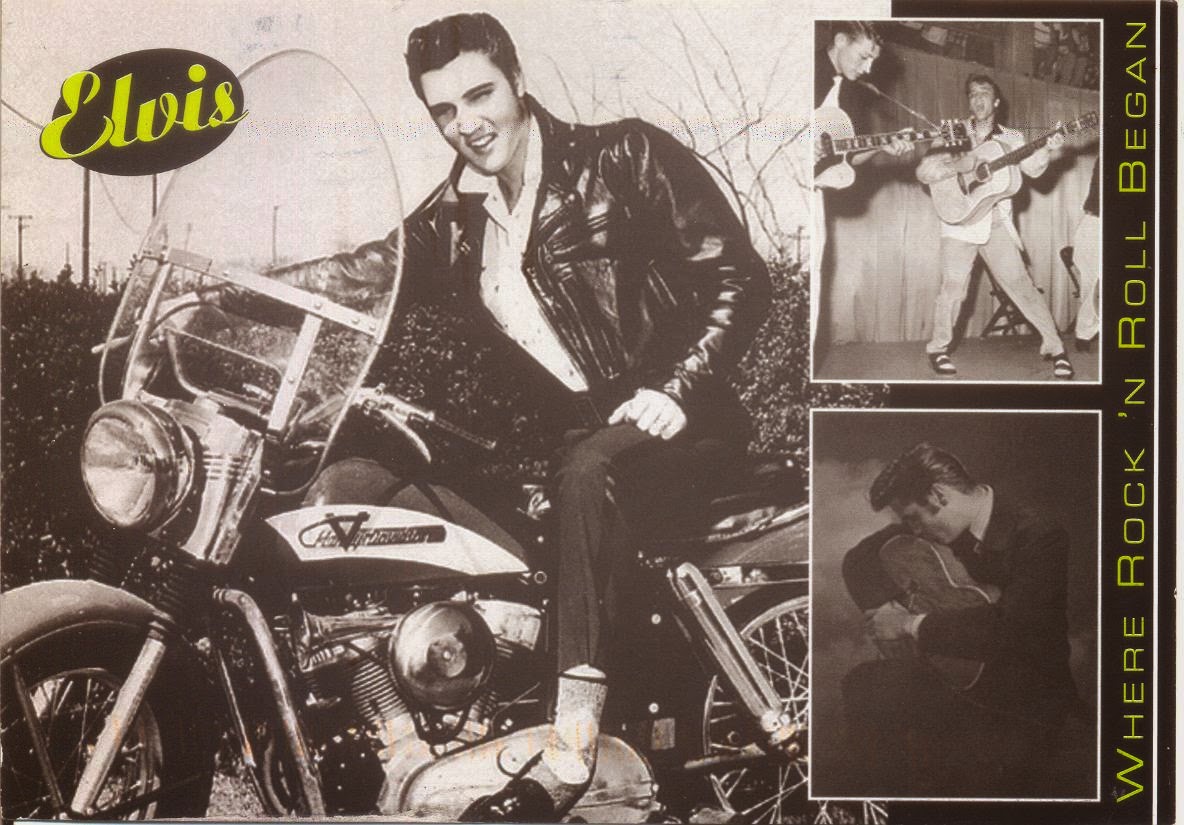
This card featuring my favourite singer was sent to me by Kelsey from Memphis.
Elvis Aaron Presley (January 8, 1935 – August 16, 1977) was an American singer and actor. Regarded as one of the most significant cultural icons of the 20th century, he is often referred to as "the King of Rock and Roll", or simply, "the King".
Presley was born in Tupelo, Mississippi and when he was 13 years old, he and his family relocated to Memphis, Tennessee. His music career began there in 1954, when he recorded a song with producer Sam Phillips at Sun Records. Accompanied by guitarist Scotty Moore and bassist Bill Black, Presley was an early popularizer of rockabilly, an up tempo, backbeat-driven fusion of country music and rhythm and blues. RCA Victor acquired his contract in a deal arranged by Colonel Tom Parker, who managed the singer for more than two decades. Presley's first RCA single, "Heartbreak Hotel", was released in January 1956 and became a number-one hit in the United States. He was regarded as the leading figure of rock and roll after a series of successful network television appearances and chart-topping records. His energized interpretations of songs and sexually provocative performance style, combined with a singularly potent mix of influences across color lines that coincided with the dawn of the Civil Rights Movement, made him enormously popular—and controversial.
In November 1956, he made his film debut in Love Me Tender. In 1958, he was drafted into military service: He resumed his recording career two years later, producing some of his most commercially successful work before devoting much of the 1960s to making Hollywood movies and their accompanying soundtrack albums, most of which were critically derided. In 1968, following a seven-year break from live performances, he returned to the stage in the acclaimed televised comeback special Elvis, which led to an extended Las Vegas concert residency and a string of highly profitable tours. In 1973, Presley was featured in the first globally broadcast concert via satellite, Aloha from Hawaii. Several years of prescription drug abuse severely damaged his health, and he died in 1977 at the age of 42.
Presley is one of the most celebrated and influential musicians of the 20th century. Commercially successful in many genres, including pop, blues and gospel, he is the best-selling solo artist in the history of recorded music, with estimated record sales of around 600 million units worldwide. He won three Grammys, also receiving the Grammy Lifetime Achievement Award at age 36, and has been inducted into multiple music halls of fame. Forbes named Elvis Presley as the 2nd top earning dead celebrity with $55 million as of 2011.
Friday, October 10, 2014
Socorro, New Mexico

In 1598 Juan de Onate’s Spanish colonization expedition
arrived here at the Piro Pueblo at Pialbo. They renamed it Socorro owing to the food and shelter provided by Pialbo’s
inhabitants. The pueblo and its Spanish mission were destroyed during the Pueblo Revolt, and the area was
not resettled until 1815. A west bank road connected Socorro to the Camino Real
on the east side of the Rio Grande.
Thank you Sam-Quito
for this nice card from New Mexico.
Saturday, May 03, 2014
Battleship Missouri Memorial

With
the collapse of the Soviet Union in the early 1990s and the absence
of a perceived threat to the United States came drastic cuts in the defense
budget, and the high cost of maintaining and operating battleships as part of
the United States Navy's active fleet became uneconomical; as a result, Missouri was
decommissioned on 31 March 1992 at Long Beach, California. Her last
commanding officer, Captain Albert L. Kaiss, wrote in the ship's final Plan of
the Day:
Our
final day has arrived. Today the final chapter in battleship Missouri’s
history will be written. It's often said that the crew makes the command. There
is no truer statement ... for it's the crew of this great ship that made this a
great command. You are a special breed of sailors and Marines and I am proud to
have served with each and every one of you. To you who have made the painful
journey of putting this great lady to sleep, I thank you. For you have had the
toughest job. To put away a ship that has become as much a part of you as you
are to her is a sad ending to a great tour. But take solace in this—you have
lived up to the history of the ship and those who sailed her before us. We took
her to war, performed magnificently and added another chapter in her history,
standing side by side our forerunners in true naval tradition. God bless you
all.
—Captain Albert L. Kaiss
Missouri returned to be part
of the reserve fleet at Puget Sound Naval Shipyard, Bremerton, Washington,
until 12 January 1995, when she was struck from the Naval Vessel Register. She remained in Bremerton, but
was not open to tourists as she had been from 1957 to 1984. In spite of
attempts by citizens' groups to keep her in Bremerton and be re-opened as a tourist
site, the U.S. Navy wanted to pair a symbol of the end of World War II with one
representing its beginning. On 4 May 1998, Secretary of the Navy John
H. Dalton signed the donation contract that transferred her to the
nonprofit USS Missouri Memorial Association (MMA)
of Honolulu, Hawaii. She was towed from Bremerton on 23 May to Astoria,
Oregon, where she sat in fresh water at the mouth of the Columbia
River to kill and drop the saltwater barnacles and sea
grasses that had grown on her hull in Bremerton, then towed
across the eastern Pacific, and docked at Ford Island, Pearl Harbour on
22 June, just 500 yd (460 m) from the Arizona Memorial. Less
than a year later, on 29 January 1999, Missouri was
opened as a museum operated by the MMA.
Thank you Becky for this
lovely card.
Friday, May 02, 2014
The National Memorial Cemetery of the Pacific

The National
Memorial Cemetery of the Pacific (informally known as Punchbowl
Cemetery) is a national cemetery located at
Punchbowl Crater in Honolulu, Hawaii. It serves as a memorial to honor those men and women
who served in the United
States Armed Forces, and those who have given their
lives in doing so. It is administered by the National
Cemetery Administration of the
United States Department
of Veterans Affairs and is listed on the National
Register of Historic Places. Millions of visitors
visit the cemetery each year, and it is one of the most popular tourist
attractions in Hawaii.
This lovely
card was sent by Becky.
Thursday, May 01, 2014
USS Arizona Memorial


My friend Becky from Hawaii sent me these nice cards of the Arizona Memorial.
The USS Arizona Memorial, located
at Pearl Harbour in Honolulu, Hawaii, marks the resting place of
1,102 of the 1,177 sailors and Marines killed on the USS Arizona during the attack on Pearl Harbour on 7 December
1941 by Japanese imperial forces and commemorates the events of that
day. The attack on Pearl Harbor and the island of Oʻahu was the
action that led to the United States' direct involvement in World War II.
The memorial, built in
1962, is visited by more than one million people annually.[1] Accessible only by boat, it straddles the
sunken hull of the battleship without touching it. Historical information about
the attack, shuttle boats to and from the memorial, and general visitor
services are available at the associated USS Arizona Memorial
Visitor Center, which opened in 1980 and is operated by the National Park
Service. The sunken remains of the
battleship were declared a National Historic Landmark on 5 May 1989.
Saturday, January 04, 2014
The Glade Creek Grist Mill
The Glade Creek Grist Mill is a new mill that was completed in 1976 at Babcock. Fully operable, this mill was built as a re-creation of one which once ground grain on Glade Creek long before Babcock became a state park. Known as Cooper's Mill, it stood on the present location of the park's administration building parking lot.
 Of special interest, the mill was created by combining parts and pieces from three mills which once dotted the state. The basic structure of the mill came from the Stoney Creek Grist Mill which dates back to 1890. It was dismantled and moved piece by piece to Babcock from a spot near Campbelltown in Pocahontas County. After an accidental fire destroyed the Spring Run Grist Mill near Petersburg, Grant County, only the overshot water wheel could be salvaged. Other parts for the mill came from the Onego Grist Mill near Seneca Rocks in Pendleton County.
A living monument to the over 500 mills which thrived in West Virginia at the turn of the century, the Glade Creek Grist Mill provides freshly ground cornmeal which park guests may purchase depending on availability and stream conditions. Visitors to the mill may journey back to the time when grinding grain by a rushing stream was a way of life, and the groaning mill wheel was music to the miller's ear.
Thank you Katie for this lovely card.
Thursday, December 05, 2013
Sault Ste. Marie

Now here’s an interesting place in the US of A. Sault Ste. Marie is a city in and the county seat of Chippewa County in the U.S. state of Michigan. It lies on the northeastern end of Michigan'sUpper Peninsula, on the Canadian border, separated from its twin city of Sault Ste. Marie, Ontario, by the St. Marys River. The city is relatively isolated from other communities in Michigan. The population was 14,144 at the 2010 census, making it the second most populous city in the Upper Peninsula.
Sault Ste. Marie was already a place of Native American settlement 500 years ago. It became the first European settlement in the region that became the Midwestern United States, when, in 1668, Father Jacques Marquette, having heard of the Native American village, traveled there to found a Catholic mission. A fur-trading settlement quickly grew at the crossroads that straddled the banks of the river, the center of a trading route of 3,000 miles (4,800 km) that extended from Montreal to the Sault, and from the Sault to the country north of Lake Superior.
The settlement formed a single community until 1817, when a US–UK Joint Boundary Commission fixed the border between the Michigan Territory of the USA and the British Province of Upper Canada to follow the river in this area. The American and Canadian communities were each incorporated as municipalities toward the end of the nineteenth century.
Sault Sainte-Marie translates from French as "the Rapids of Saint Mary". The Saint Mary's River runs from Lake Superior to Lake Huron, separating the twin border cities.
No hyphens are used in the English spelling, which is otherwise identical to the French, but the pronunciations differ; Anglophones say /ˌsuː seɪnt məˈriː/ and Francophones say [so sɛ̃t maʁi]. In both languages, the name is often written Sault Ste. Marie. On both sides of the border, the towns and the general vicinity are called The Sault or The Soo.
The two cities are joined by the International Bridge which connects Interstate Highway 75 in Sault Ste. Marie, Michigan, and Huron Street in Sault Ste. Marie, Ontario. Shipping traffic in the Great Lakes system bypasses the rapids via the American Soo Locks, the world's busiest canal in terms of tonnage passing through it, while smaller recreational and tour boats use the Canadian Sault Ste. Marie Canal. The city's downtown sits on an island, with the locks to the north, and the Sault Ste. Marie Power Canal to the south.
People come from around the world to view shipping traffic pass through the locks. The largest ships are 1,000 feet (300 m) long by 105 feet (32 m) wide. These are domestic carriers (called lakers) too large to transit the Welland Canal that bypasses Niagara Falls and, consequently, are land-locked. Foreign ships (termed salties) are smaller.
Sault Ste. Marie is also the home of the International 500 Snowmobile Race (commonly called the I-500), which takes place annually and draws participants and spectators from all over the U.S. and Canada. The race, which was inspired by the Indianapolis 500, originated in 1969 and has been growing ever since.
Thank you Bethaney for this nice card.
Thursday, October 24, 2013
The Wild West

Thank you Norbert for this pretty card.
Saturday, October 19, 2013
The Riverwalk

San Antonio (Spanish for "Saint Anthony") is the seventh most populous city in the United States of America and the second most populous city in the state of Texas, with a population of 1.3 million
San Antonio was named for Saint Anthony of Padua, whose feast day is on June 13, when a Spanish expedition stopped in the area in 1691.Famous for Spanish missions, the Alamo, the River Walk, the Tower of the Americas, the Alamo Bowl, Marriage Island and host to SeaWorld and Six Flags Fiesta Texas theme parks. The city is home to the four-time NBA champion San Antonio Spurs and theannual San Antonio Stock Show & Rodeo, one of the largest in the country.
San Antonio has a strong military presence—it is home to Fort Sam Houston, Lackland Air Force Base, Randolph Air Force Base (which constitute Joint Base San Antonio), Lackland AFB/Kelly Field Annex and Brooks City-Base, with Camp Bullis and Camp Stanley outside the city. Kelly Air Force Base operated out of San Antonio until 2001, when the airfield was transferred over to Lackland AFB .
The picture on the card sent to me by Diane Marie of San Antonio is that of The famous San Antonio River Walk (also known as Paseo del Río) is a network of walkways along the banks of the San Antonio River, one story beneath the streets of Downtown San Antonio, Texas, USA. Lined by bars, shops and restaurants, the River Walk is an important part of the city's urban fabric and a tourist attraction in its own right.
Today, the River Walk is an enormously successful special-case pedestrian street, one level down from the automobile street. The River Walk winds and loops under bridges as two parallel sidewalks lined with restaurants and shops, connecting the major tourist draws from the Alamo to River centre Mall, to the Arneson River Theatre, to Marriage Island, to La Villita, to Hemis Fair Park, to the Tower Life Building, to the San Antonio Museum of Art, and the Pearl Brewery. During the annual springtime Fiesta San Antonio, the River Parade features flowery floats that "float" down the river.
Wednesday, October 02, 2013
The Billiard Room

Located in the Bachelor’s Wing of George W. Vanderbilt’s country chateau, the Billiard Room was a place where men would retire after dinner to smoke and play billiards. True to Victorean fashion, women rarely, if ever, entered this male domain.
The Billiard Room, part of Biltmore House’s Bachelor's Wing. Decorated with an ornamental plaster ceiling and rich oak paneling the Billiard Room was equipped with both a pool table and a carom table (table without pockets.) This room was mostly an attraction to men, yet welcoming the ladies if they chose to stop by. Secret door panels on either side of the fireplace led to the private quarters of the Bachelors’ Wing.
Thank you very much indeed Sarah for this nice card.
Sunday, September 08, 2013
Norman Percevel Rockwell

The
painting on this card sent to me by Mamiko
from Japan was by Norman Percevel
Rockwell (February 3, 1894 – November 8, 1978), who was a 20th-century
American painter and illustrator. His works enjoy a broad popular appeal in the
United States for their reflection of American culture. Rockwell is
most famous for the cover illustrations
of everyday life scenarios he created for The Saturday Evening Post magazine
for more than four decades. Among the best-known of Rockwell's works are
the Willie Gillis series, Rosie the Riveter, Saying Grace (1951), The
Problem We All Live With, and the Four Freedoms series. He is also
noted for his work for the Boy Scouts of America (BSA), producing
covers for their publication Boys' Life, calendars, and other
illustrations.
For
"vivid and affectionate portraits of our country," Rockwell received
the Presidential Medal of Freedom, the United States of America's highest
civilian honour, in 1977.
Rockwell
died November 8, 1978, of emphysema at age 84 in Stockbridge,
Massachusetts. First Lady Rosalynn Carter attended his funeral.
Saturday, September 07, 2013
The Indiana Soldiers and Sailors Monument

The Indiana Soldiers and Sailors Monument is a 284 ft 6 in (86.72 m)-tall neoclassical mo
The Monument was erected to honor Hoosiers who were veterans of the American Revolution, territorial conflicts that partially led up to the War of 1812, the Mexican-American War, the US Civil War, and the Spanish American War. In addition to its external commemorative statuary and fountains (made primarily of oolitic limestone and bronze), the basement of the monument contains the Colonel Eli Lilly Civil War Museum, a museum of Indiana history during the American Civil War.
At the top of the Monument is an observation deck that can be reached by stairs at no cost or by elevator for a $2.00 charge (elevator brings you to the level just under the observation deck, with 30 additional steps). The staircase contains 331 steps, 330 of which are numbered. In 1902 the cost to build this Monument was (US) $598,318. It has been estimated that building a similar structure today would cost over $500,000,000.
It is about 21 feet (6.4 m) shorter than the 305-foot (93 m) tall Statue of The approaches to the Monument are guarded by bronze statues of four wartime leaders: George Rogers Clark, military conqueror of the Old Northwest; William Henry Harrison, first governor of the Indiana Territory and general during the War of 1812 (and, later, 9th President of the United States); James Whitcomb, governor of Indiana during the Mexican-American War; and Oliver Morton, governor during the Civil War.
The Circle is surrounded by retail shops, including the South Bend Chocolate Factory; studios for several local radio stations; the Hilbert Circle Theatre, home of the Indianapolis Symphony Orchestra; financial institutions; the Columbia Club, one of the oldest social clubs of Indiana; Christ Church Cathedral, a historic Episcopal church; and the IPL corporate headquarters. The Circle is the standard symbol of the city of Indianapolis, and the flag of Indianapolis is an iconic representation of Monument Circle and the two streets (Meridian and Market) that feed in and out of it.
Every Christmas season the Monument is decorated as an enormous Christmas tree. This city tradition is known as the Circle of Lights and has been done annually since 1962. The tree lighting ceremony is held the day after Thanksgiving.
Thank you Dear Krissy for this wonderful card.
Sunday, August 25, 2013
Frederic Sackrider Remington - painter, illustrator, sculptor, and writer

Frederic Sackrider Remington (October 4, 1861 – December 26, 1909) was an American painter, illustrator, sculptor, and writer who specialized in depictions of the Old American West, specifically concentrating on the last quarter of the 19th-century American West and images of cowboys, American Indians, and the U. S. Cavalry.
Remington was the most successful Western illustrator in the “Golden Age” of illustration at the end of the 19th Century and the beginning of the 20th Century, so much so that the other Western artists such as Charles Russell and Charles Schreyvogel were known during Remington’s life as members of the “School of Remington”. His style was naturalistic, sometimes impressionistic, and usually veered away from the ethnographic realism of earlier Western artists such as George Catlin. His focus was firmly on the people and animals of the West, with landscape usually of secondary importance, unlike the members and descendants of theHudson River School, such as Frederic Edwin Church, Albert Bierstadt, and Thomas Moran, who glorified the vastness of the West and the dominance of nature over man. He took artistic liberties in his depictions of human action, and for the sake of his readers’ and publishers’ interest. Though always confident in his subject matter, Remington was less sure about his colors, and critics often harped on his palette, but his lack of confidence drove him to experiment and produce a great variety of effects, some very true to nature and some imagined.
In 1888, he achieved the public honor of having two paintings used for reproduction on U. S. Postal stamps. Remington Himself was honored in the, Famous Americans Series postal Issues of 1940.
Thank you Dear Jenny for this card with the lovely painting by Fredrick Remmington. As a little boy I admired cowboys. I still like Western movies.
Sunday, July 28, 2013
Mark Twain

Samuel Langhorne Clemens (November 30, 1835 – April 21, 1910), better known by his pen name Mark Twain, was an American author and humorist. He wrote The Adventures of Tom Sawyer (1876) and its sequel, Adventures of Huckleberry Finn (1885), the latter often called "the Great American Novel."
Twain grew up in Hannibal, Missouri, which provided the setting for Huckleberry Finn and Tom Sawyer. After an apprenticeship with a printer, he worked as a typesetter and contributed articles to his older brother Orion's newspaper. He later became a riverboat pilot on the Mississipp River before heading west to join Orion in Nevada. He referred humorously to his singular lack of success at mining, turning to journalism for the Virginia City Territorial Enterprise. In 1865, his humorous story, "The Celebrated Jumping Frog of Calaveras County" was published, based on a story he heard at Angels Hotel in Angels Camp California where he had spent some time as a miner. The short story brought international attention, even being translated to classic Greek. His wit and satire, in prose and in speech, earned praise from critics and peers, and he was a friend to presidents, artists, industrialists, and European royalty.
Though Twain earned a great deal of money from his writings and lectures, he invested in ventures that lost a great deal of money, notably the Paige Compositor, which failed because of its complexity and imprecision. In the wake of these financial setbacks he filed for protection from his creditors via a bankruptcy filing, and with the help of Henry Huttleston Rogers eventually overcame his financial troubles. Twain chose to pay all his pre-bankruptcy creditors in full, though he had no responsibility to do this under the law.
Twain was born shortly after a visit by Halley's Comet, and he predicted that he would "go out with it," too. He died the day following the comet's subsequent return. He was lauded as the "greatest American humorist of his age“, and William Faulkner called Twain "the father of American literature."
Thank you Ron for this card, that features an author and a man I have admired since I first read “Tom Sawyer”. In those days, many a time did I day dream of being young Tom J
Saturday, July 27, 2013
James Bond in "Thunderball"

This
picture postcard features the James Bond "Thunderball" one sheet
movie poster by An Original Vintage Theatrical Folded One-Sheet
Movie Poster by Robert McGinnis and
Frank McCarthy.
Ian Fleming's Thunderball, the 1965 Terence Young
English James Bond 007 secret agent spy espionage fantasy action adventure
thriller "L007k OUT!"; "L007k up! L007k down! L007k
out!"; "Here comes the biggest Bond of all!";
"Based on the original story by Kevin McClory, Jack Whittingham and Ian
Fleming") starring Sean Connery(asJames
Bond 007), Claudine Auger, Adolfo Celi, Luciana Paluzzi, Rik Van
Nutter, Martine Beswick, Guy Doleman, Molly Peters, Bernard Lee (as
"M"), Lois Maxwell (as
Miss Moneypenny), and Desmond Llewellyn (as "Q").
Thank you Jeff from Saginaw
in Michigan for this nice card of my favourite Hollywood actor.
Thursday, June 13, 2013
Ithaca College

Aimee sent me this pretty
card. What a nice and peaceful scene at the Ithaca College. I’d love to lie
down under one of those trees and keep watching the ducks and geese the whole
day.
Ithaca College for those who are
interested is a private college located on the South Hill
of Ithaca, New York, United States. The school was founded by William
Egbert in 1892 as a conservatory of music. The college has a strong liberal
arts core, but also offers several pre-professional programs and some
graduate programs. The college is also known internationally for its
communications program:the Roy H. Park School of Communications.
The college is set
against the backdrop of Cayuga Lake, the city of Ithaca, and
several waterfalls and gorges. The college is perhaps best known
for its large list of alumni who play or have played substantial roles in the
world ofbroadcasting. The college has been ranked among the top ten master's
universities in the North by U.S. News & World Report every
year since 1996. For the 2010 rankings, the college was ranked 7 in this
category.
Wednesday, April 24, 2013
Rocky Mountain National Park

This nice card was sent to me by Dede.
Tuesday, April 16, 2013
The Pre-Columbian era Pottery

Indigenous peoples of the Americas continue to evolve after the pre-Columbian era. Many of these peoples and their descendants continue traditional practices, while evolving and adapting new cultural practices and technologies into their lives.
The pottery shown on the card is that of a Jaguar Effigy bottle with Bridge Spout with Resist from Peru. Far North Coast Piura Valley. It is possibly of the Late Horizon/Early Intermediate period, Vicus 400-200 bc.
Resist is a coating that is put on pottery or ceramic to protect a certain area from paint or glaze. When the piece is fired, the resist will burn away and the area that it was put on will show with the paint or glaze surrounding it.
Thank you Billy for this interesting card.
Subscribe to:
Posts (Atom)