Inge Look sent me this card featuring the proverbial Grannies.
Surprisingly the Grannies are shown after what must have been a small quarrel. This is indeed exceptional as usually they are the best of friends always laughing and having lots of fun together.
This blog is for sharing my picture postcards received from time to time with folks who may be similarly interested. Please also see my stamps and first day covers blog www.letstalkstamps.blogspot.com
Welcome
Добро пожаловать к этому международному месту открытки изображения.
Benvenuto a questo luogo internazionale della cartolina di immagine.
Καλωσορίστε σε αυτήν την διεθνή περιοχή καρτών εικόνων.
Willkommen zu diesem internationalen Abbildungspostkarteaufstellungsort.
Bienvenue à cet emplacement international de carte postale.
Onthaal aan deze Internationale plaats van de beeldprentbriefkaar.
Welcome to this International picture postcard site.
(Please Click on the Picture for an Enlarged View)
Showing posts with label Finland. Show all posts
Monday, May 02, 2016
Wednesday, December 23, 2015
Monday, November 16, 2015
Inge Look and her Aunties
Inge Look (Ingeborg Lievonen) was born in Helsinki, Finland in 1951. As child she and her family lived in a seven story apartment building in the city. It was literally teeming with tenants... so many people, personalities and smells. The two that quickly captivated Inge's attention were Alli and Fifi, two older women who's exuberance for life was contagious.
She refers to them as the "Aunties" and they became the inspiration for her very popular cards. The motto for these two fabulous old ladies is...
Thank you Ella.
She refers to them as the "Aunties" and they became the inspiration for her very popular cards. The motto for these two fabulous old ladies is...
"Time is not money and spending it isn’t a sin."
Wednesday, September 30, 2015
15th World Gymnaestrada 2015 Helsinki
The World Gymnaestrada
2015 Helsinki
was the best festival of the summer of 2015! It was a perfect mixture of
festival, friendship and joy. Seven days full of gymnasts’ passion and talent,
good spirit and unity. The 15th World Gymnaestrada rounded up the Gymnastics
World in Helsinki in July!
Helsinki,
together with the whole metropolitan area, was ready to welcome the international
gymnastics family as guests. The Finnish Ministry of Education and Culture,
Cities of Helsinki, Vantaa and Espoo, the Finnish Gymnastics Federation and the
Local Organising Committee worked closely with each other to make this event
come to life. This top team is also living its own dream of organising a
worldwide Gymnastics for All events with enthusiasm and excitement.
The
Finnish summer is at its best in July. Warm days and a sun that doesn’t really
set provided an unforgettable experience to all of the participants of the 15th World Gymnaestrada.
Thank you Ella.
Monday, May 25, 2015
Finnish Summer
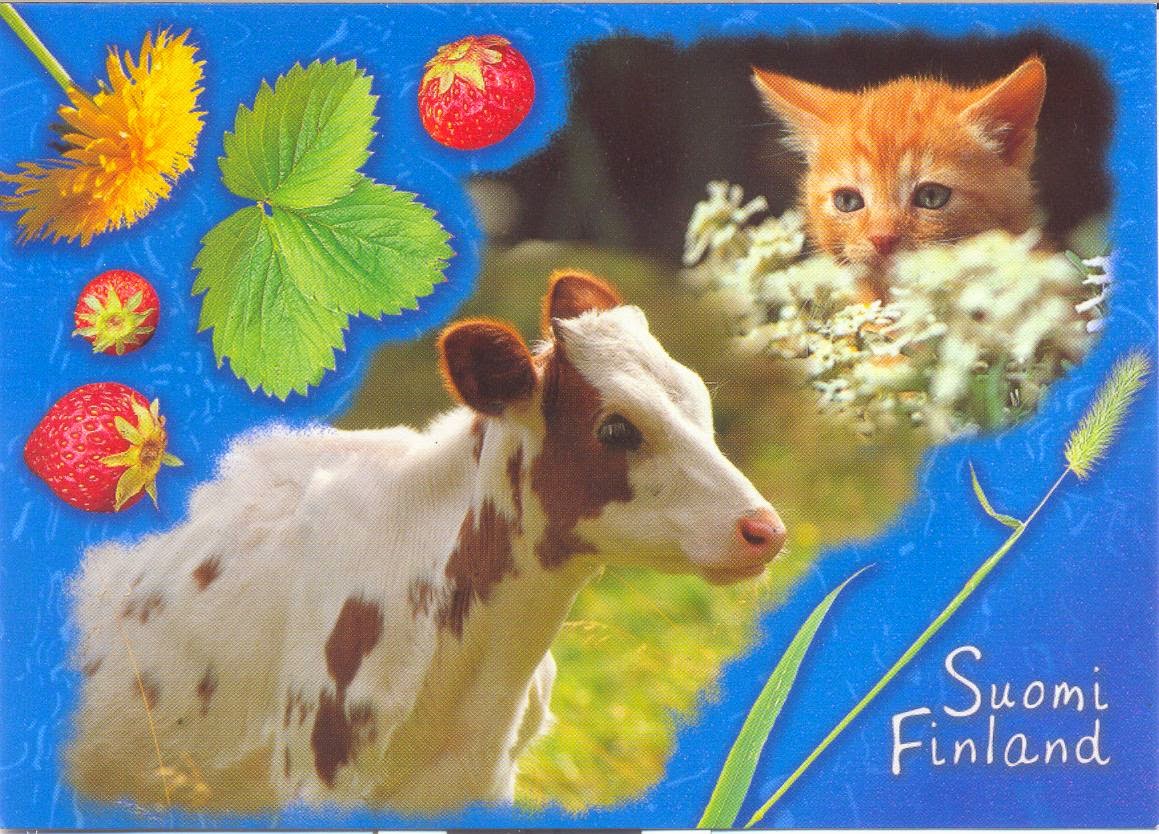
Thank you Ari for this lovely card of the Finnish Summer that you guys are enjoying. The strawberries make my mouth water. I believe it is 15 to 18 degrees in your part of the world.
Its not too bad here in New Delhi where I live. The day before yesterday was the highest so far this Summer - only 44.5. Not bad eh! :-))
Sunday, January 04, 2015
Inge Löök
Inge Löök (real name Ingeborg Lievonen)
is a Finnish artist born in Helsinki in 1951. She was once a professional
gardener, but today she is most famous for her Granny postcards which so many
love and collect. If you like you can
view some of them on this blog.
I was very
fortunate to get this card addressed to me and signed personally by Inge Löök
herself. And all this happened because of My friend Ella in Helsinki. Thank you
Ella.
Thursday, November 13, 2014
Wednesday, November 12, 2014
Christmas stamps 2014
This maxicard shows his
year’s Finnish Christmas stamps, the artwork of Kristina Segercrantz,
famous for several award-winning book illustrations. With these stamps executed
with watercolor technique, Segercrantz wants to create a true Christmas
fairy-tale atmosphere. In the blue-hued Christmas Eve Christmas-tariff
stamp, an elf girl enjoys the enchanting
atmosphere with a Christmas reindeer in candlelight. In the other Christmas
stamp, the orange-hued Christmas Morning 1st-class stamp, an elf rings a large Christmas bell, feet
off the ground.
The graphic design of
the Christmas stamps comes from Olavi Hankimo.
Thank you Ella.
Monday, October 20, 2014
Kouvola Railway Station, 1902.
Kouvola is
a town and municipality in
south-eastern Finland.
It is located 134 kilometres (83 mi) northeast of the capital, Helsinki.
The
city has a population of 86,943 (31 January 2014) and
covers an area of 2,883.30 square kilometres (1,113.25 sq mi) of
which 325.06 km2(125.51 sq mi) is water. The population
density is
33.99 inhabitants per square kilometre (88.0 /sq mi).
Kouvola's
central location within Finland's borders and as a border post between the European
Union and Russian
Federation makes
it a quite lively town.] The town originally grew up around
the junction of the north-south and east-west rail tracks. It was also a major
road transport junction.
The card sent to me by Reino shows the Kouvola Railway Station
as it was in 1902.
Saturday, October 18, 2014
World Post Day in Helsinki
The picture on the card is that of The Market Square in
Helsinki at the South Harbour. The market is internationally famous. The booths
here sell traditional market foods and treats, as well as handicrafts and
souvenirs. There is also a heated café tent where you can comfortably sip
steaming hot coffee even on the coldest days in winter.
South Harbour is a bay and harbour area immediately
next to the centre of the city of Helsinki, Finland. It is the largest
passenger harbour in Finland, and 5.4 million passengers travel through it
every year. Most of the harbour's traffic is to Stockholm, Sweden and Tallinn,
Estonia, and for cruises.
Ella sent me this card essentially as it was World Postal or Stamp Day on 9.10.2014. The
stamp is a personalised one by the Post Office in Helsinki. The stamp shows an
illuminated water front in Helsinki. The postmark is peculiar to Helsinki only
on this day.
I had featured a maxi card about Philately Day in Helsinki in 2013
(see my post dated 3.11.2013).
Saturday, October 04, 2014
Tom of Finland
Touko Laaksonen (8
May 1920 – 7 November 1991), best known by his pseudonym Tom
of Finland, was a Finnish artist
notable for his stylized homoerotic fetish art and
his influence on late twentieth century gay culture. He has been called the
"most influential creator of gay pornographic images" by cultural
historian Joseph W. Slade.
Over
the course of four decades he produced some 3500 illustrations, mostly
featuring men with exaggerated primary and secondary sex traits with tight or
partially removed clothing.
During his lifetime and beyond,
Laaksonen's work has drawn both admiration and disdain from different quarters
of the artistic community. Laaksonen developed a friendship with gay
photographer Robert
Mapplethorpe, whose work depicting sado-masochism and f etish iconography was
also subject to controversy.
A
controversial theme in his drawings was the erotic treatment of men in Nazi
uniforms. They form a small part of his overall work, but the typically
flattering visual treatment of these characters has led some viewers to infer
sympathy or affinity for Nazism, and they have been omitted from most recent
anthologies of his work. Later in his career Laaksonen disavowed this work and
was at pains to dissociate himself and his work from fascist or racist
ideologies. He also depicted a significant number of black men in his drawings,
with no overt racial or political message in the context in which they appear;
although they bear some commonality with racist caricatures of
the "hypersexual" black male, these traits are shared by Laaksonen's
white characters as well.
Art
critics have mixed views about Laaksonen's work. His detailed drawing technique
has led to him being described as a 'master with a pencil', while in contrast a
reviewer for Dutch newspaper Het Parool described
his work as 'illustrative but without expressivity'.
There
is considerable argument over whether his depiction of 'supermen' (male
characters with huge sexual organs and muscles) is facile and distasteful, or
whether there is a deeper complexity in the work which plays with and subverts
those stereotypes. For example, some critics have noted instances of apparent
tenderness between traditionally tough, masculine characters, or playful smiles
in sado-masochistic scenes.
In
either case, there remains a large constituency who admire the work on a purely
utilitarian basis, as described by Rob Meijer, owner of a leather shop
and art gallery in Amsterdam, "These works are not conversation pieces,
they're masturbation pieces."
Writing
for Artforum,
Kevin Killian said that seeing Tom of Finland originals “produces a strong
respect for his nimble, witty creation”. Kate Wolf writes that “Tom of Finland
helped pave the way to gay liberation”.
Thank you Dear Ella for these interesting cards.
Friday, June 20, 2014
Spring Flowers
It would not be spring without a flower stamp. This year's stamp depicts a viola. Illustrated by Leena Airikkala, the 1st class Bunch of Violas stamp will be published in a sheet of ten stamps. The plant theme is familiar to Airikkala. Her Apple Blossom stamp was selected as the most beautiful Finnish stamp in 2005.
Thank you Dear Ella for this lovely maxicard.
Monday, June 16, 2014
Finnish Summer Landscapes
The stamp on this lovely maxicard depicting landscapes in summer in Finland, is one of a set of six pretty stamps.
The themes include sunsets, lakes and the sea, fields, and forests. With his photographs, Janne Gröning wants to relay relaxing and therapeutic nature experiences to all who cannot or do not have the time to visit nature themselves. The views featured on the stamps were photographed in Iniö, the lsland of Keistiö, the shore of Lake Näsijärvi, Nauvo, and the Salo region.
Thank you Ella.
Monday, March 31, 2014
Thursday, March 20, 2014
Alavus, a city of Finland
Sanna sent me this card with pictures of important sites in the village of Tuuri. This is a village in Alavus, a city of Finland.
Tuuri is located in the province of Western Finland and is part of the Etelä-Pohjanmaa region. The village has a population of 500. The name"Tuuri" originates in the old Finnish god of luck, harvest and success, Tuuri; he was the equivalent of Norse Thor and Estonian Taara.
In Modern Finnish the appellative tuuri means luck.
The village is known for the second biggest department store in Finland, Veljekset Keskinen. The massive golden horseshoe erected over the shopping mall stands at number three in Reuters' list of world's ugliest buildings and monuments.
Saturday, March 01, 2014
M/aux Astrid
"ASTRID" is a traditional English
sailing vessel, crewed by experienced sailors well
acquainted with the Finnish archipelago.
The ship is fitted discreetly with all conveniences needed for Both work and leisure. ASTRID's galley too is equipped to satisfy the demands of all.
Thank you Merja for this pretty card.
sailing vessel, crewed by experienced sailors well
acquainted with the Finnish archipelago.
The ship is fitted discreetly with all conveniences needed for Both work and leisure. ASTRID's galley too is equipped to satisfy the demands of all.
Thank you Merja for this pretty card.
Tuesday, February 18, 2014
100th anniversary of the Finnish artist and writer behind the Moomins

Tove Jansson, world-famous for the Moomins, was a versatile artist who completed many paintings, works of graphic arts and public works of art during her career. In addition to the Moomin books, she received recognition for her short stories and novels. Tove Jansson was a prolific artist whose career started in the 1930s and continued long into the 1990s.
An
experimental artist and a writer with an eye for details. As an artist, Jansson mastered many techniques
and held exhibitions that took her art into new and sometimes experimental
directions. In addition to paintings, her works include a lot of works of
graphic arts and public works of art from murals to mosaics. Throughout her life,
open-mindedness and the pursuit of freedom were among Tove Jansson's strengths.
Tove
Jansson also became known as a writer who put her mind to writing with the
utmost meticulousness. Her short stories and novels are known for minimalistic
narration and careful composition.
The
Moomins remain popular from generation to generation. The first time Jansson drew the Moomintroll character it was for Garm,
a liberal and satirical magazine that sniped at the world of global leaders
during the Second World War. The Moomins and
the Great Flood,
published in 1945, was the first in a series of books that became the most
visible and best-known part of Tove Jansson's career. The third Moomin book, Finn Family Moomintroll, was published in 1948 and increased
Jansson's fame outside Finland and Sweden.
In the
1950s, Tove Jansson started to draw and write a Moomin comic strip for the most
widely read evening newspaper in the world, Evening
News, which was
published in London. Soon the comic strip was read in more than 20 countries.
The
popularity of the Moomins has continued from generation to generation. The
Moomin books have been translated into more than 30 languages and the Moomins
have become familiar figures on television, in films, on theatre stages and in
opera, too.
Thank you Ella for these lovely maxi cards depicting one of my favourite author and artist and the other showing the popular characters she created.
Monday, February 10, 2014
Turku Castle
Turku Castle is a medieval building in the city of Turku in Finland. Together with Turku Cathedral, the castle is one of the oldest buildings still in use in Finland. Turku Castle is the largest surviving medieval building in Finland. It was founded in the late 13th century and stands on the banks of the Aura River.
The castle was ruled in different stages of its history by the castle sheriff, commander, regent, duke or governor-general. Its significance as a defensive fortress and administrative centre varied throughout the ages according to the political situation. Only once did the castle actually figure in the defence of the realm. This was when Russian invaders from Novgorod destroyed Turku in 1318. On the other hand, it frequently played a role in internal struggles for power within Sweden-Finland and the Kalmar Union. Not until the end of 16th century did it really enjoy peace. The castle lost its status as an administrative centre in the 17th century after Per Brahe's period as governor-general of Finland came to an end.
Many accidents have assailed the castle, especially numerous sieges. In 1614, when King Gustav II Adolf visited the castle, a tremendous fire destroyed the wooden structure of the main castle almost completely. After this the main castle was abandoned and used partly as a store, partly just stood empty. A new accident beset the castle in the summer of 1941 soon after the Continuation War had begun when an incendiary bomb hit the main castle.
Thank you Ella for these five lovely maxi cards of the ancient castles of Finland.
Sunday, February 09, 2014
Kastelholm Castle
Kastelholm Castle is a Swedish-built medieval castle located off Road 2 in Sund, Åland, Finland, approximately 25 km (16 mi) northeast of Mariehamn, overlooking a fjord to the south of the village of Kastelholm. Along with Hämeenlinna, Olavinlinna in Savonlinna, Raasepori, and Turku, Kastelholm is one of only five surviving Finnish medieval fortresses that are also considered to be architecturally substantial. Built in the 14th century, and held in fief during the Middle Ages by various nobles, feudal chiefs, and kings, it had significant period in the 15th and 16th centuries.
Built in the 14th century, originally on a small island surrounded by moats filled with water and planted with several rows of poles, the castle has been of strategic importance in consolidating Swedish authority over the Baltic over the last several centuries; with several Swedish monarchs parading through the history. It was first damaged in the 1599 civil war when it came under king Charles IX control and was rebuilt by 1631. The castle was gutted and ruined in 1745. In the 1930s, it was partially used as a granary. However, since then it has been refurbished and is now an important part of the tourist circuit in Åland.
Saturday, February 08, 2014
Häme Castle
Häme Castle is a medieval castle in Hämeenlinna, Finland. The castle is located on the banks of lake Vanajavesi in the city center. The castle was originally located on an island.
The castle's age is disputed. Traditionally the construction of the castle has been connected to the legendary Second Swedish Crusade which would date the castle in the mid-13th century. However, there are no finds from the castle that can be firmly dated to a period earlier than 1320s. Also the contents of the crusade legend have been seriously contested. An earlier fortification from about 1300, some 20 kilometres (12 mi) away in Hakoinen also makes a 14th-century dating for Häme Castle more probable. Only one castle ("Tauestahus") is listed in Tavastia in a royal document from 1308. Also, the Russian Novgorod Chronicle onl
“The men of Novgorod went to war over sea to the country of the Germans (Swedes), against the Finnish (Yem) people – – And the Germans fell back into the citadel. For the place was very strong and firm, on a high rock, not having access from any side. And they sent with greeting, asking for peace, but the men of Novgorod did not grant peace, and they stood three days and three nights wasting the district”.
The construction of Häme castle probably started after the Novgorod invasion. The first castle was made of gray stone, and later bricks were used.The castle lost military importance by the end of the 16th century. Its defensive systems were upgraded in the 18th century with bastions around the castle. The castle became a prison in the 19th century and served as such until 1953, when massive restoration work started. The castle has been a museum since 1988.
Subscribe to:
Posts (Atom)