Welcome

Добро пожаловать к этому международному месту открытки изображения. Benvenuto a questo luogo internazionale della cartolina di immagine. Καλωσορίστε σε αυτήν την διεθνή περιοχή καρτών εικόνων. Willkommen zu diesem internationalen Abbildungspostkarteaufstellungsort. Bienvenue à cet emplacement international de carte postale. Onthaal aan deze Internationale plaats van de beeldprentbriefkaar. Welcome to this International picture postcard site. (Please Click on the Picture for an Enlarged View)

Thursday, November 28, 2013

Walter Scheel


Walter Scheel (born 8 July 1919) is a German politician (FDP). He served as Federal Minister of Economic Cooperation and Development from 1961 to 1966, Foreign Minister of Germany and Vice Chancellor from 1969 to 1974, acting Chancellor of Germany from 7 to 16 May 1974 (following the resignation of Willy Brandt after the Guillaume Affair), and finally as President of the Federal Republic of Germany from 1974 to 1979.
He is currently the oldest former German president alive and the longest-lived German head of state.
Thank you Maria for this maxi card.

Wednesday, November 27, 2013

Merry Christmas


Merry Christmas says Tonnie from Holland. Merry Christmas to you too Dear Tonnie.

Tuesday, November 26, 2013

The Santa Maria

La Santa María de la Inmaculada Concepción (Spanish for The Holy Mary of the Immaculate Conception), or La Santa María, was the largest of the three ships used by Christopher Columbus in his first voyage. Her master and owner was Juan de la Cosa.
The Santa María was probably a medium sized nao (carrack), about 58 ft (17.7 m) long on deck, and according to Juan Escalante de Mendoza in 1575, the Santa Maria was "very little larger than 100 toneladas" (About 100 tons, or tuns) burthen, or burden, and was used as the flagship for the expedition. The other ships of the Columbus expedition were the smaller caravel-type ships Santa Clara, remembered as La Niña ("The Girl"), and La Pinta ("The Painted"). All these ships were second-hand (if not third or more) and were not intended for exploration. The Niña, Pinta, and the Santa María were modest sized merchant vessels comparable in size to a modern cruising yacht, and not the largest ships in Europe at the time. The exact measurements of length and width of the three ships have not survived, but good estimates of their burden capacity can be judged from contemporary anecdotes written down by one or more of Columbus' crew members, and contemporary Spanish and Portuguese ship wrecks from the late 15th and early 16th centuries which are comparable in size to that of the Santa Maria; These include the ballast piles and keel lengths of the Molasses Reef Wreck and Highborn Cay Wreck in the Bahamas. Both were caravel type vessels 19 m (62 ft) in length overall, 12.6 m (41 ft) keel length and 5 to 5.7 m (16 to 19 ft) in width, and rated between 100 and 150 tons burden. The Santa María, being Columbus' largest ship, was only about this size, and the Niña and Pinta were even tinier, at only 50 to 75 tons burden and perhaps 15-18 meters (50 to 60 feet) on deck (updated dimensional estimates are discussed below in the section entitled Replicas).

Monday, November 25, 2013

Anny von Hamburg

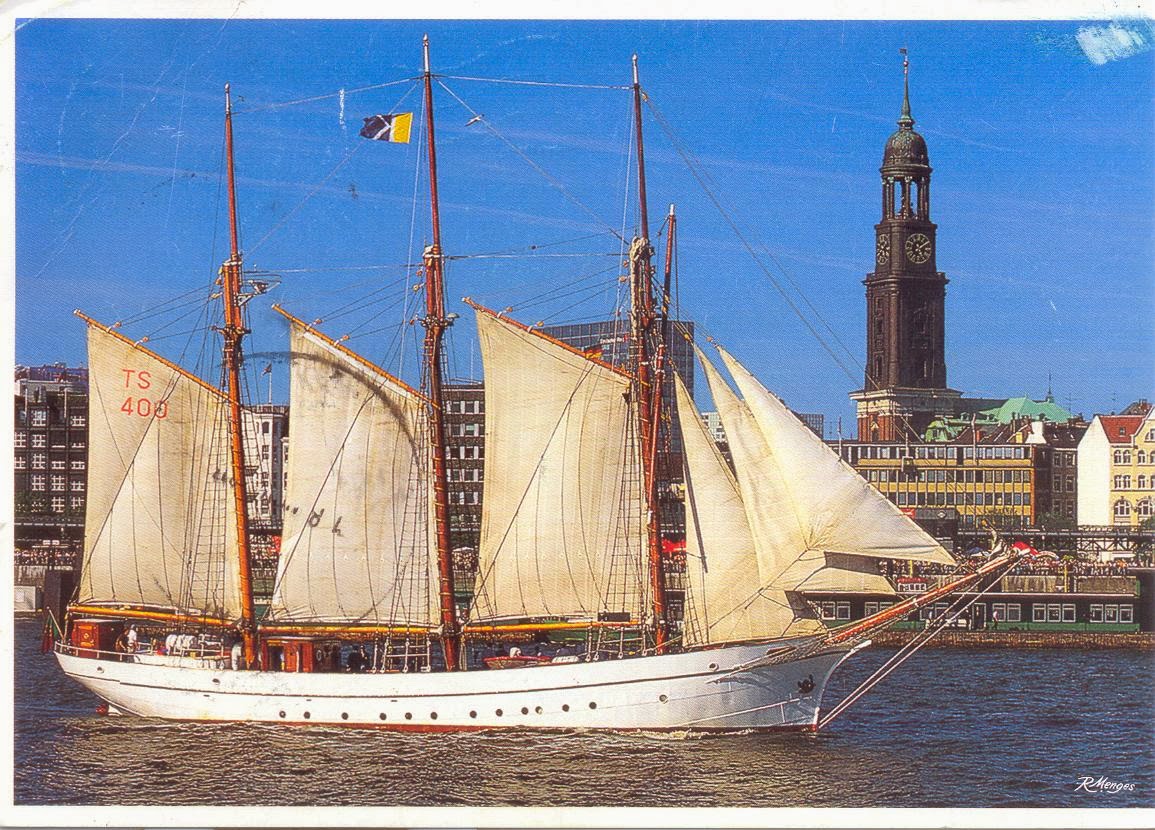
Thank you Jessica for this lovely card showing the three masted gaff rigged schooner "Anny von Hamburg" in Hamburg harbour.
Hamburg, is the second largest city in Germany and the ninth largest city in the European Union. On the river Elbe, the port of Hamburg is the second largest port in Europe (after the Port of Rotterdam) and tenth largest worldwide.
The official name reflects its history as a member of the medieval Hanseatic League, as a free imperial city of the Holy Roman Empire, and that it is a city-state, and one of the 16 states of Germany.  
Hamburg is a major transport hub and is one of the most affluent cities in Europe. It has become a media and industrial centre. Hamburg has been an important financial centre for centuries, and is the seat of the world's second oldest bank, Berenberg Bank.

The city is a major tourist destination for both domestic and overseas visitors; it ranked 17th in the world for livability in 2012, and in 2010 it ranked 10th in the world.

Thursday, November 21, 2013

The school classroom

Ella sent me this very expressive card. The theme of which is obviously the classroom. The school classroom which is the very corner-stone of Finland's enviable success in the field of education. The stamp on this card and the card itself salutes and commemorates those responsible for success in education in Finland. For more on this issue please see my post on my stamps blog www.letstalkstamps.blogspot.com today.

Wednesday, November 20, 2013

Merry Christmas


My friend Ella sent me these cards issued by Itella Posti for Christmas this year. The stamps on them are of special significance as this is the 40th Anniversary of Finnish Christmas  stamps. You can get more info on my other blog namely www:/letstalkstamps.blogspot.com. Thank you Ella for these lovely cards.

Friday, November 08, 2013

Belgrade

My friend Karoly sent me this card of Belgrade, showing a few important sites there. Belgrade is the capital and largest city of Serbia. It is located at the confluence of the Sava and Danube rivers, where the Pannonian Plain meets the Balkans. Its name translates to White city. The city proper has a population of over 1.2 million; 1.65 million people live within the administrative limits.
One of the most important prehistoric cultures of Europe, the Vinča culture, evolved within the Belgrade area in the 6th millennium BC. In antiquity, Thraco-Dacians inhabited the region, and after 279 BC Celts conquered the city, naming it Singidūn. It was conquered by the Romans during the reign ofAugustus, and awarded city rights in the mid 2nd century. It was settled by the Slavs in the 520s, and changed hands several times between the Byzantine Empire, Frankish Empire, Bulgarian Empire and Kingdom of Hungary before it became the capital of Serbian King Stephen Dragutin (1282–1316). In 1521, Belgrade was conquered by the Ottoman Empire and became the seat of the Sanjak of Smederevo. It frequently passed from Ottoman to Habsburg rule, which saw the destruction of most of the city during the Austro-Ottoman wars. Belgrade was again named the capital of Serbia in 1841. Northern Belgrade remained the southernmost Habsburg post until 1918, when the city was reunited. As a strategic location, the city was battled over in 115 wars and razed to the ground 44 times. Belgrade was the capital of Yugoslavia (in various forms of governments) from its creation in 1918, to its final dissolution in 2006.
Belgrade has a special administrative status within Serbia and it is one of five statistical regions of Serbia. Its metropolitan territory is divided into 17 municipalities, each with its own local council. It covers 3.6% of Serbia's territory, and 22.5% of the country's population lives in the city. The city has been awarded many titles, and the nomination for European Capital of Culture 2020.