Welcome

Добро пожаловать к этому международному месту открытки изображения. Benvenuto a questo luogo internazionale della cartolina di immagine. Καλωσορίστε σε αυτήν την διεθνή περιοχή καρτών εικόνων. Willkommen zu diesem internationalen Abbildungspostkarteaufstellungsort. Bienvenue à cet emplacement international de carte postale. Onthaal aan deze Internationale plaats van de beeldprentbriefkaar. Welcome to this International picture postcard site. (Please Click on the Picture for an Enlarged View)
Showing posts with label Belgium. Show all posts

Thursday, March 27, 2014

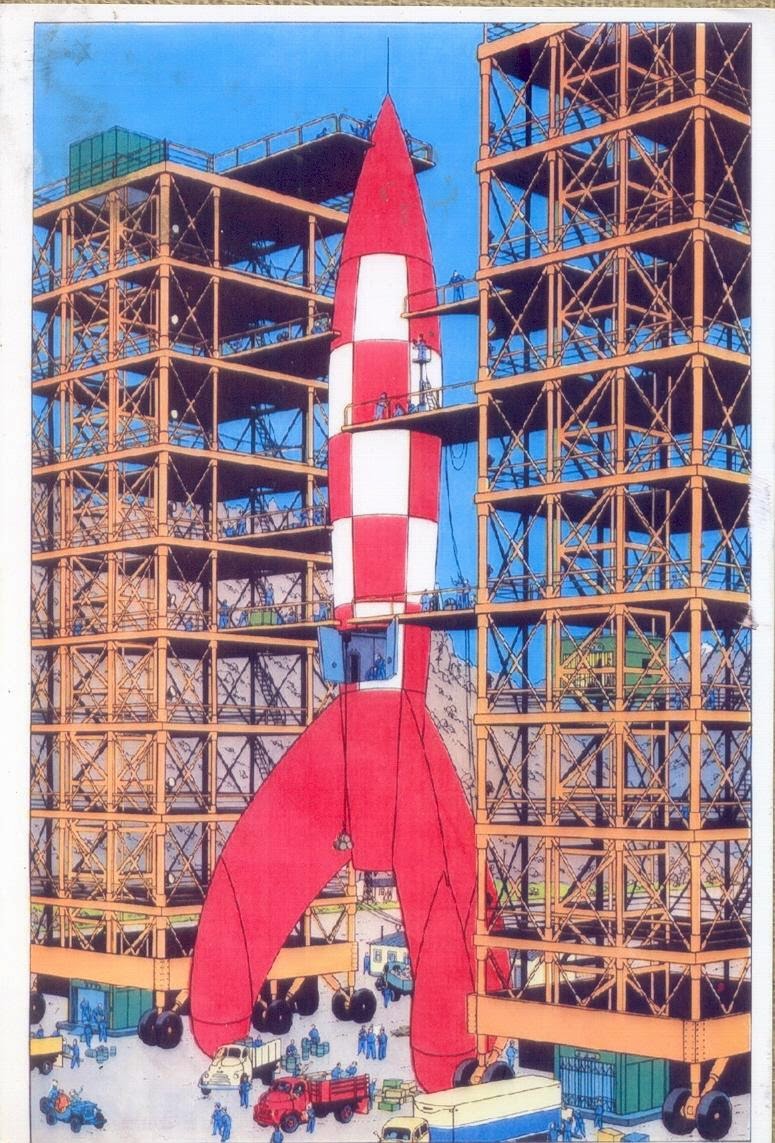
Tintin

The Adventures of Tintin (Les Aventures de Tintin) is a series of comic albums created by Belgian cartoonist Georges Remi (1907–1983), who wrote under the pen name Hergé. The series was one of the most popular European comics of the 20th century, and it remains popular today. By the time of the centenary of Hergé's birth in 2007, Tintin had been published in more than 70 languages with sales of more than 200 million copies.
The series first appeared in French on 10 January 1929 in Le Petit Vingtième, a youth supplement to the Belgian newspaper Le Vingtième Siècle. The success of the series saw the serialised strips published in Belgium's leading newspaper Le Soir and spun into a successfulTintin magazine. In 1950, Hergé created Studios Hergé, which produced the canonical series of twenty-four Tintin albums. The Adventures of Tintin have been adapted for radio, television, theatre, and film.
The series is set during a largely realistic 20th century. Its hero is Tintin, a young Belgian reporter. He is aided by his faithful fox terrier dog Snowy (Milou in the original French edition). Later, popular additions to the cast included the brash and cynical Captain Haddock, the highly intelligent but hearing-impaired Professor Calculus, and other supporting characters such as the incompetent detectives Thomson and Thompson (French: Dupont et Dupond) and the opera diva Bianca Castafiore.
The series has been admired for its clean, expressive drawings in Hergé's signature ligne claire ("clear line") style. Its well-researched plots straddle a variety of genres: swashbuckling adventures with elements of fantasy, mysteries, political thrillers, and science fiction. The stories feature slapstick humour, offset by dashes of sophisticated satire and political or cultural commentary.
Felix sent me this nice card from Germany.

Tuesday, July 09, 2013

The Cathedral of Our Lady

The Cathedral of Our Lady is a Roman Catholic cathedral in Antwerp, Belgium. Today's see of the Diocese of Antwerp was started in 1352 and, although the first stage of construction was ended in 1521, has never been 'completed'. In Gothic style, its architects were Jan and Pieter Appelmans. It contains a number of significant works by the Baroque painter Peter Paul Rubens, as well as paintings by artists such as Otto van Veen, Jacob de Backer and Marten de Vos.
The cathedral is on the list of World Heritage Sites.
Where the cathedral now stands, there was a small chapel of Our Lady from the 9th to the 12th century, which acquired the status of parish church in 1124. During the course of the twelfth century, it was replaced by a larger Romanesque church (80 metres (260 ft) long and 42 metres (138 ft) wide).
In 1352, construction was begun on a new Our Lady’s church which would become the largest Gothic church in the Netherlands. In the beginning, it was to be provided with two towers of equal height. In 1521, after nearly 170 years, the new church of Our Lady was ready. The south tower reached only as far as the third string course.
During the night of 5–6 October 1533, the new church was largely gutted by fire. The completion of the second tower was therefore delayed, which led to its ultimate postponement. Moreover, the church only became cathedral of the bishopric of Antwerp in 1559 but lost this title again from 1801 to 1961, following the Concordat of 1801. During the Iconoclasm of 20 August 1566 (at the start of the Eighty Years' War), Protestants destroyed a large part of the cathedral interior. Later, when Antwerp came under Protestant administration in 1581, a number of artistic treasures were once again destroyed, removed or sold. The restoration of Roman Catholic authority came in 1585 with the fall of Antwerp.
In 1794 the French revolutionaries who conquered the region plundered Our Lady’s Cathedral and inflicted serious damage. Around 1798, the French administration intended to demolish the building but after each blow, the cathedral was able to recover. In 1816, various important works of art were returned from Paris, including three Rubens masterpieces. And over the course of the 19th century, the church was completely restored and refurnished.
Between 1965 and 1993, a complete restoration took place.
My friend Hildegarde sent me this nice card.

Friday, February 05, 2010

Belgium – Leuven University Library


The Catholic University of Leuven, or Louvain, was the largest, oldest and most prominent university in Belgium. Pope Martin V founded the Old University in 1425. After the disruptions of the French Revolutionary Wars, it was re-founded in 1816 as the State university of Louvain and converted into the Catholic University of Leuven in 1835.
In 1968 the university split to form two institutions:
  • Katholieke Universiteit Leuven, Dutch-speaking, situated in Leuven; and
  • Université catholique de Louvain, French-speaking, situated in Louvain-la-Neuve, Belgium.
In 1914, during World War I, Leuven was looted by German troops. They set fire to a large part of the city, effectively destroying about half of it. The library was lost, as well as about 300,000 books; and a huge collection of manuscripts, such as the Easter Island tablet bearing Rongorongo text E. In the early stages of the war, allied propaganda capitalized on the German destruction as a reflection on German Kultur.
The new main library was built between 1921 and 1928 and designed by the American architect Whitney Warren in Low Countries neo-renaissance style. Its monumentality is a reflection of the Allied victory against Germany. It is one of the largest university buildings in the city. In 1940, during the second German invasion of Leuven, the building largely burnt down, including its (at that time) 900,000 manuscripts and books. Rebuilt after the war in accordance with Warren's design, it is now the Central Library of the Katholieke Universiteit Leuven. The paintwork decorations of the original design were completed only in 2000, and marked the 575th anniversary of the university's foundation. Thank you Thomas for sending me this card from Leuven.