Welcome

Добро пожаловать к этому международному месту открытки изображения. Benvenuto a questo luogo internazionale della cartolina di immagine. Καλωσορίστε σε αυτήν την διεθνή περιοχή καρτών εικόνων. Willkommen zu diesem internationalen Abbildungspostkarteaufstellungsort. Bienvenue à cet emplacement international de carte postale. Onthaal aan deze Internationale plaats van de beeldprentbriefkaar. Welcome to this International picture postcard site. (Please Click on the Picture for an Enlarged View)

Thursday, July 26, 2012

Conservation & Protection of Nature


Conservation is an ethic of resource use, allocation, and protection. Its primary focus is upon maintaining the health of the natural world its, fisheries, habitats, and biological diversity. Secondary focus is on materials conservation and energy conservation, which are seen as important to protect the natural world. Those who follow the conservation ethic and, especially, those who advocate or work toward conservation goals are termed conservationists.
The conservation movement, also known as nature conservation, is a political, environmental and a social movement that seeks to protect natural resources including animal, fungus and plant species as well as their habitat for the future. The early conservation movement included fisheries and wildlife management, water, soil conservation and sustainable forestry. The contemporary conservation movement has broadened from the early movement's emphasis on use of sustainable yield of natural resources and preservation of wilderness areas to include preservation of biodiversity. Some say the conservation movement is part of the broader and more far-reaching environmental movement, while others argue that they differ both in ideology and practice. Chiefly in the United States, conservation is seen as differing from environmentalism in that it aims to preserve natural resources expressly for their continued sustainable use by humans. In other parts of the world conservation is used more broadly to include the setting aside of natural areas and the active protection of wildlife for their inherent value, as much as for any value they may have for humans.
The United Nations Postal Services issued a stamp on 19th November 1982, which is shown on this maxicard with the special postmark of that day. Merja gave me this card.

Wednesday, July 25, 2012

Welcome to Loviisa


Pia sent me this card from Loviisa, which is a municipality and town of around 16000 inhabitants (31 January 2012) on the southern coast of Finland. The town centre is located about 87 km east of Helsinki, along the road to St. Petersburg. The new City of Loviisa (Lovisa in Swedish) was born on January 1st 2010 when former municipalities of Loviisa, Liljendal, Pernaja and Ruotsinpyhtää were merged together. Loviisa is best known for its fortifications, the wooden houses in its Old Town and the Strömfors Iron Works. Both Finnish and Swedish (the two official languages of Finland) are traditionally spoken in the Loviisa area.
Loviisa was founded in 1745, as a border fortress against Russia. Most of the fortifications have been preserved. It is named after Lovisa Ulrika, the Swedish Queen consort of Adolf Frederick of Sweden. Loviisa is the site of one of Finland's two nuclear power stations, the other being at Olkiluoto.  

Tuesday, July 24, 2012

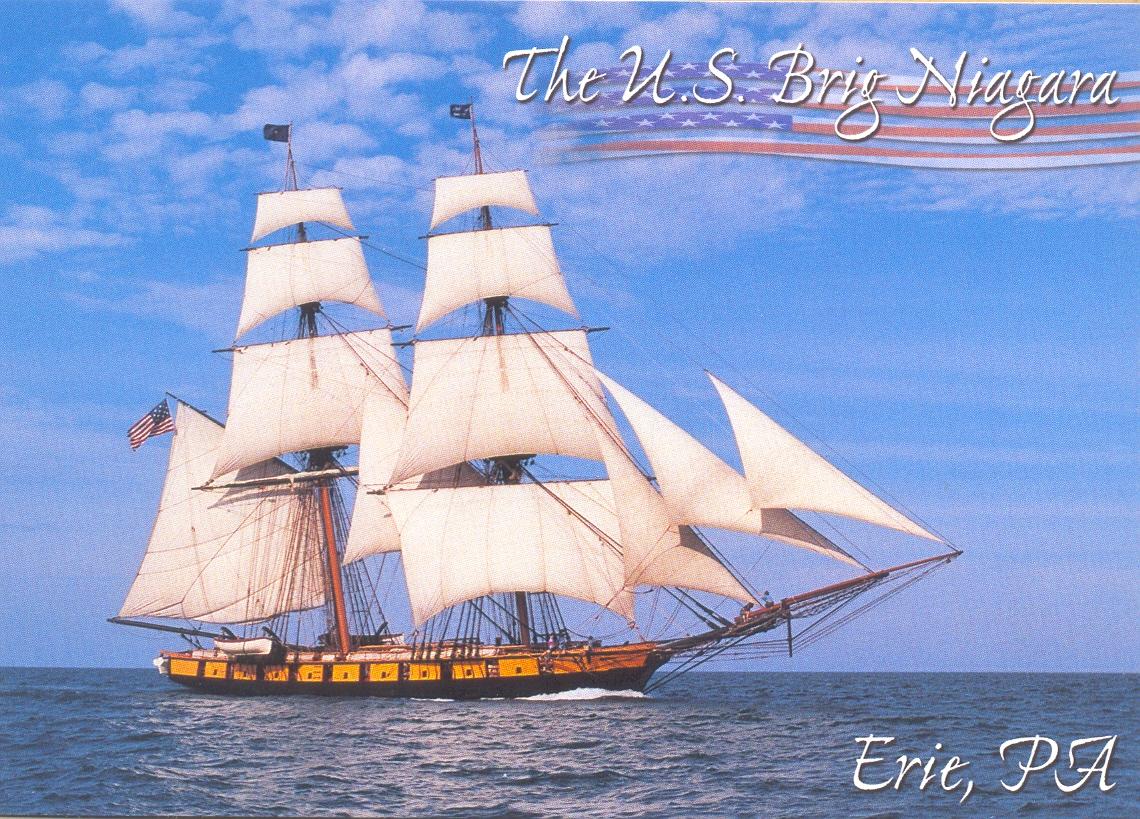
US Brig Niagara


US Brig Niagara or the Flagship Niagara, is a wooden-hulled brig that served as the relief flagship for Oliver Hazard Perry in the Battle of Lake Erie during the War of 1812. It is one of last remaining ships from the War of 1812. The Niagara is usually docked behind the Erie Maritime Museum in downtown Erie in the U.S. state of Pennsylvania as an outdoor exhibit for the museum, but travels the Great Lakes during the summer, serving as an ambassador of Pennsylvania when not docked. It was listed on the National Register of Historic Places in 1973 and was designated the official state ship of Pennsylvania by the Pennsylvania General Assembly in 1988. This lovely card was sent to me by Maria.

Monday, July 23, 2012

1600th Anniversary of Saint Theodul or Saint Joder


Maria sent me this maxicard with The 80-rappen postage stamp on it. The picture is of the fourth 'Saint Joder' stamp published by the Postal Service in Vaduz. Bishop Saint Joder is shown with a bunch of grapes. 'Saint Joder is the Patron saint of farmers and vintners. The patron saint of Triesenberg, Saint Theodul (or Saint Joder) is once again appearing on a Liechtenstein postage stamp, in especially impressive form. Once again a worthy jubilee is a legitimate occasion for the issuance of a special stamp, this time in celebration of the 1600-year festival of this legendary saint. His history, going back to the year 381, is presented by a scholar, former Deacon Engelbert Bucher (Triesenberg). The horizontal stamp shows the Theodul statue from the parish church of Laterns. The sculpture, of about the year 1500, from the old Vorarlberg forest settlement indubitably belongs to the most beautiful visual images of the saint. The stamp was designed by Bruno Kaufmann and Walter Wachter.

Sunday, July 22, 2012

Cargolux 747-400F LX YCV


This 747-400F LX YCV (Freighter) shown on the card is on the taxiway at Seattle, USA. It is an all freight version which uses the fuselage design of the 747-200F. The aircraft's first flight was on May 4, 1993, and it entered service with Cargolux on November 17, 1993. Major customers included Atlas Air, Cargolux, China Airlines, Korean Air, Nippon Cargo Airlines, Polar Air Cargo, and Singapore Airlines. The −400F can be easily distinguished from the passenger −400 by its shorter upper-deck hump. Whatever the configuration, I have always loved to be on a 747:-))
The 747-400F has a main deck nose door and a mechanized cargo handling system. The nose door swings up so that pallets or containers up to 40 ft (12 m) can be loaded straight in on motor-driven rollers. An optional main deck side cargo door (like the 747-400M (Combi)) allows loading of dimensionally taller cargo modules. Boeing delivered 126 Boeing 747-400F aircraft with no unfilled orders as of November 2009. The last −400F was delivered to Nippon Cargo Airlines. This pretty card was sent to me by Katya from Russia.

Saturday, July 21, 2012

Hannover - The Kröpcke Clock


Hanover or Hannover, on the river Leine, is the capital of the federal state of Lower Saxony (Niedersachsen), Germany and was once by personal union the family seat of the Hanoverian Kings of Great Britain, under their title as the dukes of Brunswick-Lüneburg (later described as the Elector of Hanover). At the end of the Napoleonic Wars, the Electorate was enlarged to become the capital of the Kingdom of Hanover.
In addition to being the capital of Lower Saxony, Hanover was the capital of the administrative area Regierungsbezirk Hannover (Hanover region) until Lower Saxony's administrative regions were disbanded at the beginning of 2005. Since 2001 it is part of the Hanover district (Region Hannover), which is a municipal body made up from the former district (Landkreis Hannover) and city of Hanover (note: although both Region and Landkreis are translated as district they are not the same).
With a population of 522,686 (31 December 2010) the city is a major centre of northern Germany, known for hosting annual commercial trade fairs such as the Hanover Fair and the CeBIT. Every year Hanover hosts the Schützenfest Hannover, the world's largest marksmen's festival, and the Oktoberfest Hannover, the second largest Oktoberfest in the world. In 2000, Hanover hosted the world fair Expo 2000. The Hanover fairground, due to numerous extensions, especially for the Expo 2000, is the largest in the world. Hanover is also of national importance because of its universities and medical school, its international airport, and its large zoo. The city is also a major crossing point of railway lines and highways (Autobahnen), connecting European main lines in east-west-direction (Berlin - Ruhr area) and north-south-direction (Hamburg - Munich et al.).
And, what you see on the card is the The Kröpcke Clock. Hannover's most famous meeting spot, located above the Kröpcke underground train station, the main station of City Center. This Kröpcke Clock is a 1977 replica of the original built by Konrad Oertel in 1885 but destroyed in WWII. It takes its name from Wilhelm Kröpcke, a famous headwaiter of a cafe in the area. The four corners have all the 12 Zodiac signs on them. This lovely card was sent to me by Sisela.

Friday, July 20, 2012

The Pentagon


The Pentagon is the headquarters of the United States Department of Defence, located in Arlington County, Virginia. As a symbol of the U.S. military, "the Pentagon" is often used metonymically to refer to the Department of Defence rather than the building itself.
Designed by the American architect George Bergstrom (1876–1955), and built by Philadelphia, Pennsylvania, general contractor John McShain, the building was dedicated on January 15, 1943, after ground was broken for construction on September 11, 1941. General Brehon Somervell provided the major motive power behind the project; Colonel Leslie Groves was responsible for overseeing the project for the Army.
The Pentagon is the world's largest office building by floor area, with about 6,500,000 sq ft (600,000 m2), of which 3,700,000 sq ft (340,000 m2) are used as offices. Approximately 28,000 military and civilian employees and about 3,000 non-defence support personnel work in the Pentagon. It has five sides, five floors above ground, two basement levels, and five ring corridors per floor with a total of 17.5 mi (28.2 km) of corridors. The Pentagon includes a five-acre (20,000 m2) central plaza, which is shaped like a pentagon and informally known as "ground zero", a nickname originating during the Cold War and based on the presumption that the Soviet Union would target one or more nuclear missiles at this central location in the outbreak of a nuclear war.
On September 11, 2001, exactly 60 years after the building's groundbreaking, hijacked American Airlines Flight 77—a Boeing 757-223—was crashed into the western side of the Pentagon, killing 189 people including five hijackers, 59 others aboard the plane, and 125 working in the building.
Thank you Pam for this card.