Welcome

Добро пожаловать к этому международному месту открытки изображения. Benvenuto a questo luogo internazionale della cartolina di immagine. Καλωσορίστε σε αυτήν την διεθνή περιοχή καρτών εικόνων. Willkommen zu diesem internationalen Abbildungspostkarteaufstellungsort. Bienvenue à cet emplacement international de carte postale. Onthaal aan deze Internationale plaats van de beeldprentbriefkaar. Welcome to this International picture postcard site. (Please Click on the Picture for an Enlarged View)

Wednesday, August 31, 2011

Finnish Gunner’s of the 18th Century


A platoon of smartly dressed Finnish artillerymen with a mobile cannon in the Army of the 18th Century. This platoon was probably based in Turku. They bear a close resemblance to the Swedish-Finnish artillery of the 18th century. The uniforms worn by this group of men is similar to those used during Charles XII (King of Sweden from 1697 to 1718). This card was sent to me by one of my friends who preferres to remain anonymous.

Tuesday, August 30, 2011

Albert Gustaf Aristides Edelfelt


Albert Gustaf Aristides Edelfelt (21 July 1854 – 18 August 1905) was a Swedish-speaking Finnish painter. Albert Edelfelt was born in Porvoo, Finland. His father Carl Albert was an architect. Edelfelt admired the poet Johan Ludvig Runeberg, who was a friend of the family. The company of Runeberg had a lasting impact on Edelfelt, who from time to time turned to scenes from Finnish history in his paintings. Edelfelt went on to illustrate Runeberg's epic poem The Tales of Ensign Stål. He studied art in Antwerp (1873–1874), Paris (1874–1878) and Saint Petersburg (1881–1882). He married Baroness (friherinnan) Ellan de la Chapelle in 1888 and they had one child. Edelfelt was one of the first Finnish artists to achieve international fame. He enjoyed considerable success in Paris and was one of the founders of the Realist art movement in Finland. He influenced several younger Finnish painters and helped fellow Finnish artists such as Akseli Gallen-Kallela to make their breakthrough in Paris.

The painting on the card displayed, was titled “From the anchorage at Copenhagen III”. The card was sent to me by Jaana.

Monday, August 29, 2011

Valamo Monastery


The Valamo monastery, Finland's only Orthodox monastery, is a hidden gem. The Red Army annexed the original monastery during WWII; the latest church was consecrated in 1977. Like all good monks, the clergy at Valamo produce their own wine (which visitors can buy) using crowberries, raspberries, strawberries and blackcurrants. In February 1940, during the Winter war, Finnish government decided to evacuate Valaam monastery (located on the island in the lake Ladoga) to Finland. 200 monks, monastery library and about 60% of icons have been moved on military tracks - ice on the lake Ladoga was strong enough. Now it's the biggest Christian Orthodox centre in Finland

New Valamo or New Valaam is an Orthodox monastery in Heinävesi, Finland. The monastery was established in 1940, when some monks from Valaam Monastery in Karelia were evacuated from their old abode on a group of islands in Lake Laatokka (Ladoga) to Eastern Finland. The old (Valamo) Valaam Monastery was quite soon after the outbreak of the Winter War occupied by the armed forces of the Soviet Union. After a temporary dwelling place the monks decided to settle down in Heinävesi in Eastern Finland. The choice fell on a mansion in Papinniemi, Heinävesi, after the monks had found there, quite surprisingly, an icon of St. Sergius and St. Herman, the founders of Valaam (Valamo) monastery in the 12th century. The monks considered this to be a sign from God. Having received evacuees from the Konevsky (Konevitsa) and Pechenga (Petsamo) monasteries, it is now, the only monastery for men of the Finnish Orthodox Church.

The Finnish Orthodox Church has also a monastery for women, Lintula Holy Trinity Convent, which is situated 18 kilometres (11 miles) from New Valamo, in Palokki, Heinävesi. My dear friend Merja sent me this card.


Sunday, August 28, 2011

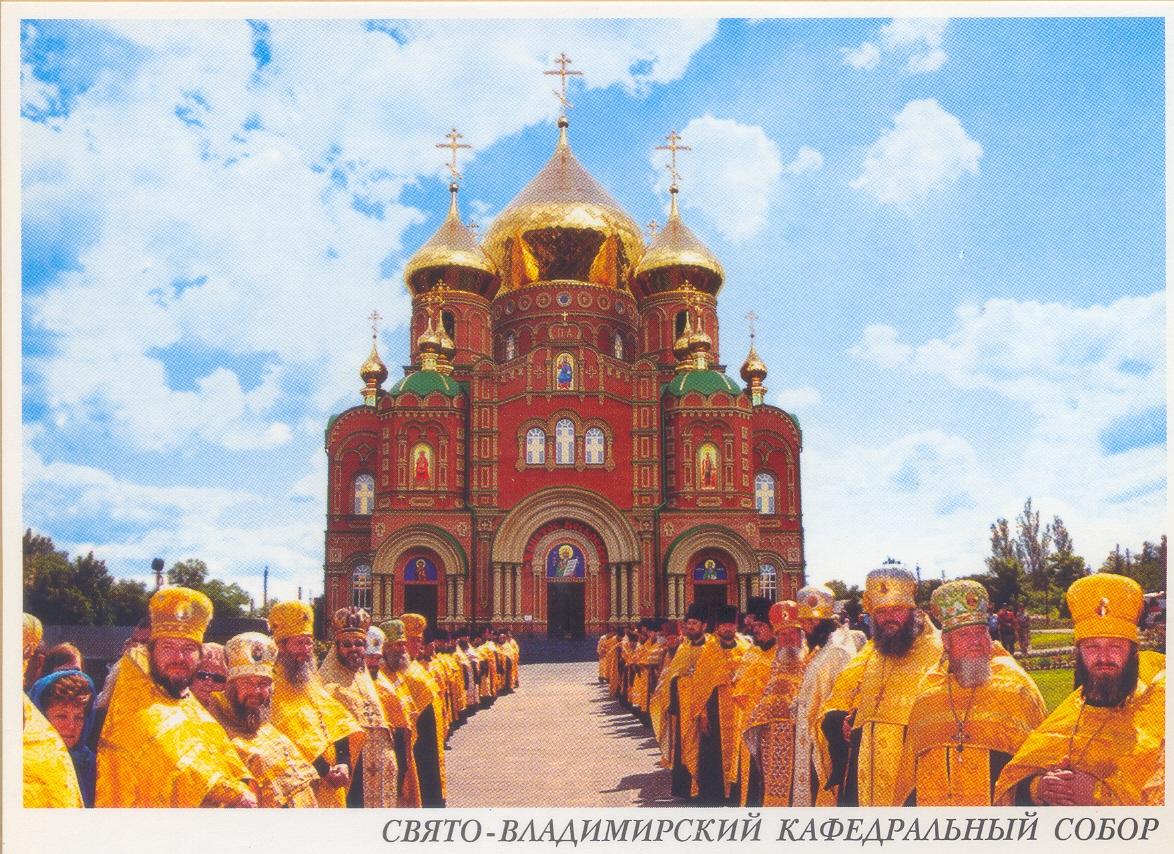
St. Vladimir Cathedral in Luhansk


Luhansk (formerly Voroshilovgrad) also known as Lugansk is a city in southeastern Ukraine. It is the administrative center of the Luhansk Oblast (province). The city itself is also designated as its own separate municipality within the oblast. The current estimated population is around 445,900 (as of 2004). Luhansk is perhaps one of the few cities in the world that was renamed four times within 55 years. During the soviet times the city was called Voroshilovgrad in tribute of the Soviet military commander Kliment Voroshilov, a native of Luhansk, exactly since November 5, 1935, but on March 5, 1958, the old name Luhansk was reinstated until 1969. On January 5, 1970, after Voroshilov dead, the name of the city was changed again to Voroshilovgrad. On May 4, 1990, a decree of the Ukrainian SSR renamed again the city with its original name.

St. Vladimir Cathedral in Luhansk this unique structure. Its construction began in 1993, laying the first stone was with the former Ukrainian President Leonid Kuchma. Cathedral was solemnly consecrated on 19 March 2006. St. Vladimir Cathedral today is the biggest religious buildings in southeast Ukraine. The Cathedral can accommodate about 3 thousand parishioners. This lovely card was sent to me by Stanislav who lives in Luhansk.

Saturday, August 27, 2011

United Nations Mission in Ethiopia and Eritrea


In June 2000, after two years of fighting in a border dispute, Ethiopia and Eritrea signed a cessation of hostilities agreement following proximity talks led by Algeria and the Organization of African Unity. In July, the Security Council set up UNMEE to maintain liaison with the parties and establish a mechanism for verifying the ceasefire. In September 2000, the Council authorized UNMEE to monitor the cessation of hostilities and to help ensure the observance of security commitments.

On 30 July 2008, the Security Council terminated the mandate of UNMEE with effect from the following day. The Council decision came in response to crippling restrictions imposed by Eritrea on UNMEE, as well as the cutting off of fuel supplies – making it impossible for the operation to continue carrying out its mandated tasks, and putting at risk the safety and security of UN personnel.

The picture shows a Corporal of a Canadian Regiment making friends with a young Ethiopian. The Obverse of the card at left gives more information regarding the card and the nice stamp affixed to the card. Thank you Ian Perry for this nice card.


Friday, August 26, 2011

PORSCHE 356


The Porsche 356 was the company's first production automobile. It was a lightweight and nimble handling rear-engine rear-wheel-drive 2 door sports car available in hardtop coupe and open configurations. Design innovations continued during the years of manufacture, contributing to its motorsports success and popularity. Production started in 1948 at Gmünd, Austria where approximately 50 cars were built. In 1950 the factory relocated to Zuffenhausen, Germany and general production of the 356 continued until April 1965, well after the replacement model 911 made its autumn 1963 debut. It is estimated approximately half of the total production of 76,000 356s still survive. Currently in Brazil, sells a replica of the Porsche 356, the Chamonix Super 90. Maria, this is indeed a lovely car to have and to ride. When you get to buy it, don’t forget that I am waiting to be in the passenger seat. Thank you for this pretty card Dear Friend.


Friday, August 19, 2011

East Coast Village in TaiwanFishing


Tobey sent me this pretty picture from Taiwan. The picture is of a fishing village on the East Coast. Tobey also affixed very pretty stamps on this card.