Welcome

Добро пожаловать к этому международному месту открытки изображения. Benvenuto a questo luogo internazionale della cartolina di immagine. Καλωσορίστε σε αυτήν την διεθνή περιοχή καρτών εικόνων. Willkommen zu diesem internationalen Abbildungspostkarteaufstellungsort. Bienvenue à cet emplacement international de carte postale. Onthaal aan deze Internationale plaats van de beeldprentbriefkaar. Welcome to this International picture postcard site. (Please Click on the Picture for an Enlarged View)

Monday, March 31, 2014

The Moomin's


Thank you Dear Ella for this lovely card with the famous Moomin family by Tove Jansson. A lot has been mentioned already about the Moomin's on this blog.

Sunday, March 30, 2014

Praha or Prague

Mirek sent me this pretty card of Praha or Prague which is the capital and largest city of the Czech Republic. Situated in the north-west of the country on the Vltava river, the city is home to about 1.3 million people, while its metropolitan area is estimated to have a population of over 2.3 million. The city has a temperate oceanic climate with warm summers and chilly winters. Prague has been a political, cultural and economic centre of Europe and particularly central Europe during its 1,100 year existence. For centuries, during the Gothic and Renaissance eras, Prague was the permanent seat of two Holy Roman Emperors and thus was also the capital of the Holy Roman Empire. Later it was an important city in the Habsburg Monarchy and the Austro-Hungarian Empire, and after World War I became the capital of Czechoslovakia. The city played major roles in the Protestant Reformation, the Thirty Years' War, and in 20th-century history, during both World Wars and the post-war Communist era. Prague is home to a number of famous cultural attractions, many of which survived the violence and destruction of twentieth century Europe. 

Main attractions include the following: Prague Castle, the Charles Bridge, Old Town Square, the Jewish Quarter, the Lennon Wall, and Petřín hill. Since 1992, the extensive historic centre of Prague has been included in the UNESCO list of World Heritage Sites. Prague boasts more than ten major museums, along with countless theatres, galleries, cinemas, and other historical exhibits. Also, Prague is home to a wide range of public and private schools, including the famous Charles University. Its rich history makes it a popular tourist destination, and the city receives more than 4.1 million international visitors annually, as of 2009. Prague is classified as a global city. 

A modern public transportation system connects the city. Prague is also accessible by road, train, and air. The card shows two very famous views of this great City. The historic centre of Prague (Hradčany with Prague Castle, the Lesser Quarter, Old Town including the Charles Bridge and Josefov, New Town and Vyšehrad) occupies an area of 866 ha and has been on UNESCO’s World Heritage List since 1992. 

Shown on the card are a few famous sites in Prague, of which one is The famous Charles Bridge across the Vltava River in Prague. This 'solid-land' connection made Prague important as a trade route between east and west Europe. The bridge was originally called theStone Bridge or the Prague Bridge but has been the "Charles Bridge" since 1870. King Charles IV's favourite architect and builder Peter Parler, originally built the present-day bridge. The initial idea was to build a functional construction for jousting tournaments, and for many years the only decoration on the bridge was a simple crucifix, but later the desire of the Catholics for ornamentation resulted in 30 statues being built (1600 to 1800 AD).

Saturday, March 29, 2014

Greater Poland Uprising of 1918–1919, or Wielkopolska Uprising

The Greater Poland Uprising of 1918–1919, or Wielkopolska Uprising of 1918–1919 or Posnanian War was a military insurrection of Poles in the Greater Poland region (also called by the Germans the Grand Duchy of Poznań or Provinz Posen region) against Germany. The uprising had a significant effect on the Treaty of Versailles, which granted a reconstituted Poland the area won by the Polish insurgents plus some additional territory, at the cost of German territory, all of which had previously been Polish territory, before the three Partitions of Poland carried out (between 1787 and 1795) by the three powerful, neighbouring Empires of Austria, Prussia and Russia.
The card depicts the Meeting convened by the Council Zobnierzy and Robotnikorz at the city council hall in Poznan on Monday 11 November1918, in which the then Mayor Ernst Wilmsa gave the call for the uprising.

Thank you Weronika.

Friday, March 28, 2014

Datteln


Datteln is a town in the district of Recklinghausen, in North Rhine-Westphalia, Germany. It is situated on a crossroads of four canals (Datteln-Hamm Canal, Wesel-Datteln Canal, Dortmund-Ems Canal and Rhein-Herne Canal), which makes it the biggest canal junction in the World, approx. 10 km north-east of Recklinghausen and 20 km north-west of Dortmund.

Katja Seizinger, former alpine skier and triple Olympic gold medallist, was born in Datteln.

These two cards were sent to me by Frank and Uwe respectively.

Thursday, March 27, 2014

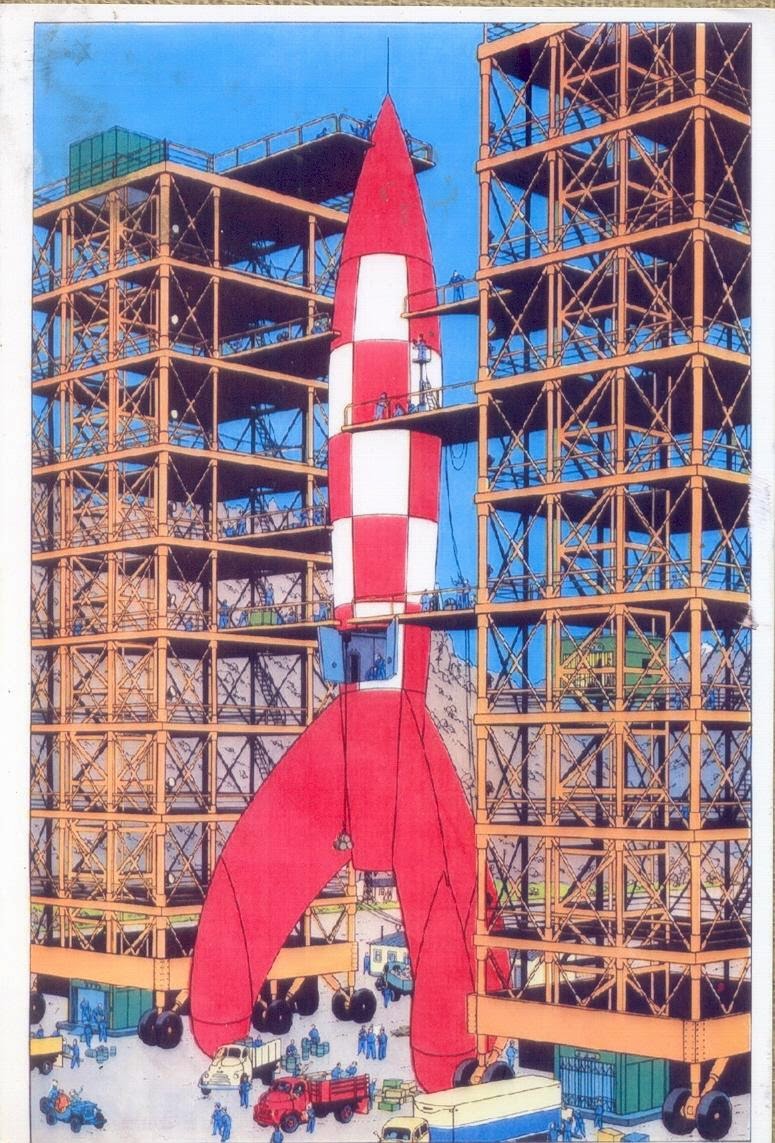
Tintin

The Adventures of Tintin (Les Aventures de Tintin) is a series of comic albums created by Belgian cartoonist Georges Remi (1907–1983), who wrote under the pen name Hergé. The series was one of the most popular European comics of the 20th century, and it remains popular today. By the time of the centenary of Hergé's birth in 2007, Tintin had been published in more than 70 languages with sales of more than 200 million copies.
The series first appeared in French on 10 January 1929 in Le Petit Vingtième, a youth supplement to the Belgian newspaper Le Vingtième Siècle. The success of the series saw the serialised strips published in Belgium's leading newspaper Le Soir and spun into a successfulTintin magazine. In 1950, Hergé created Studios Hergé, which produced the canonical series of twenty-four Tintin albums. The Adventures of Tintin have been adapted for radio, television, theatre, and film.
The series is set during a largely realistic 20th century. Its hero is Tintin, a young Belgian reporter. He is aided by his faithful fox terrier dog Snowy (Milou in the original French edition). Later, popular additions to the cast included the brash and cynical Captain Haddock, the highly intelligent but hearing-impaired Professor Calculus, and other supporting characters such as the incompetent detectives Thomson and Thompson (French: Dupont et Dupond) and the opera diva Bianca Castafiore.
The series has been admired for its clean, expressive drawings in Hergé's signature ligne claire ("clear line") style. Its well-researched plots straddle a variety of genres: swashbuckling adventures with elements of fantasy, mysteries, political thrillers, and science fiction. The stories feature slapstick humour, offset by dashes of sophisticated satire and political or cultural commentary.
Felix sent me this nice card from Germany.

Tuesday, March 25, 2014

Polar Bears


Oleg sent me this lovely card. Bliss personified! - A Polar Bear mother and her cub sleeping on ice. 

Monday, March 24, 2014

Fehmarn – Germany's sunshine isle.

Silvia sent me this card featuring  Fehmarn – Germany's sunshine isle in the Baltic Sea.

With 2,200 hours of sun every year, endless stretches of natural beaches along 78 kilometres of coastline, picturesque freshwater lakes and rugged cliffs, Fehmarn is an idyllic holiday destination. Fehmarn might have been created especially for holidaymakers in search of a relaxing, healthy break. The Baltic Sea island, covering some 185 square kilometres, has a mild yet bracing climate and is one of the sunniest places in Germany. The FehMare pool complex, located on the island's south beach promenade, is a popular attraction with a large range of wellness and recreation facilities including seawater pools, relaxation pools and a variety of saunas.