Welcome

Добро пожаловать к этому международному месту открытки изображения. Benvenuto a questo luogo internazionale della cartolina di immagine. Καλωσορίστε σε αυτήν την διεθνή περιοχή καρτών εικόνων. Willkommen zu diesem internationalen Abbildungspostkarteaufstellungsort. Bienvenue à cet emplacement international de carte postale. Onthaal aan deze Internationale plaats van de beeldprentbriefkaar. Welcome to this International picture postcard site. (Please Click on the Picture for an Enlarged View)

Friday, July 29, 2011

UK - Souter Lighthouse and The Leas

Souter is an iconic cliff top beacon, offering a great family-friendly visit. When opened in 1871, it was a technological marvel, being the first lighthouse built to use electricity. Decommissioned in 1988, the machinery remains in working order today. To the north, The Leas has two and a half miles of beach, cliff and grassland with soaring seabirds and, to the south, Whitburn Coastal Park provides walks and family trails. This year the spectacular glass optic from nearby Coquet Island Lighthouse is on display in Souter's Engine Room – offering a unique chance to see inside and outside of this vital machinery. Maria sent me this card.

Thursday, July 28, 2011

Cyprus - Spaceship Giotto


The Giotto mission was designed to study Comet Halley, and also studied Comet Grigg-Skjellerup during its extended mission. The major objectives of the mission were to: (1) obtain colour photographs of the nucleus; (2) determine the elemental and isotopic composition of volatile components in the cometary coma, particularly parent molecules; (3) characterize the physical and chemical processes that occur in the cometary atmosphere and ionosphere; (4) determine the elemental and isotopic composition of dust particles; (5) measure the total gas-production rate and dust flux and size/mass distribution and derive the dust-to-gas ratio; and, (6) investigate the macroscopic systems of plasma flows resulting from the cometary-solar wind interaction. The European spaceship “Giotto” was launched from French Guiana on July 2nd 1985 and met with Halley’s Comet on March 14, 1986.

The 18c stamp depicts the European spaceship "Giotto" launched by an Ariane rocket fro the Kourou launching site in the French Guiana on July 2, 1985. Its objective was to study Halley's comet, which it met on March 14, 1986 at a distance of 375 miles. Giotto's sensory instruments sent back to Earth a lot of information about the comet. Merja sent me this FDC. Merja sent me this interesting maxim card.

Wednesday, July 27, 2011

New Zealand - Akaroa Head Lighthouse


The original Akaroa lighthouse started operation on the precipitous headland of Akaroa Heads on 1 January 1880. One hundred years later, it was moved down to Akaroa Township, after being replaced in 1977 by an automated light. The foundations are all that remain of the lighthouse keeper's family homes, but the original stonework of the supply road down to Haylocks Bay remains along the cliff face, including an original stone culvert at the junction of the road and the small stream. Akaroa lighthouse moved to its current location in Akaroa township in 1980. Maria gave me this card.

Tuesday, July 26, 2011

China – Eight Diagrams Teapot (Qing Dynasty)

Tai ji or T'ai chi as it is better known here, literally means 'supreme','ultimate' and is seen as the perpetual cycle of Ying and Yang. This symbol is found on the teapot lid. The eight diagrams known as 'bagua' in China is a philosphical Taosit concept represented with an octangonal diagram. Its Approx size is 18cm length, 11cm wide and 7cm high. Teapot capacity is approx. 320ml. The teapot shown on the card was popular amongst the intelligentia during the Qing Dynasty. Thank you Maria for this card.

Monday, July 25, 2011

Taiwan – Tourist's Map Card


David sent me this card which was issued by the National Youth Commission, with the aim of promoting tourism in Taiwan amongst the youth of the world. The map card of Taiwan highlights the important tourist centers in Taiwan.

Sunday, July 24, 2011

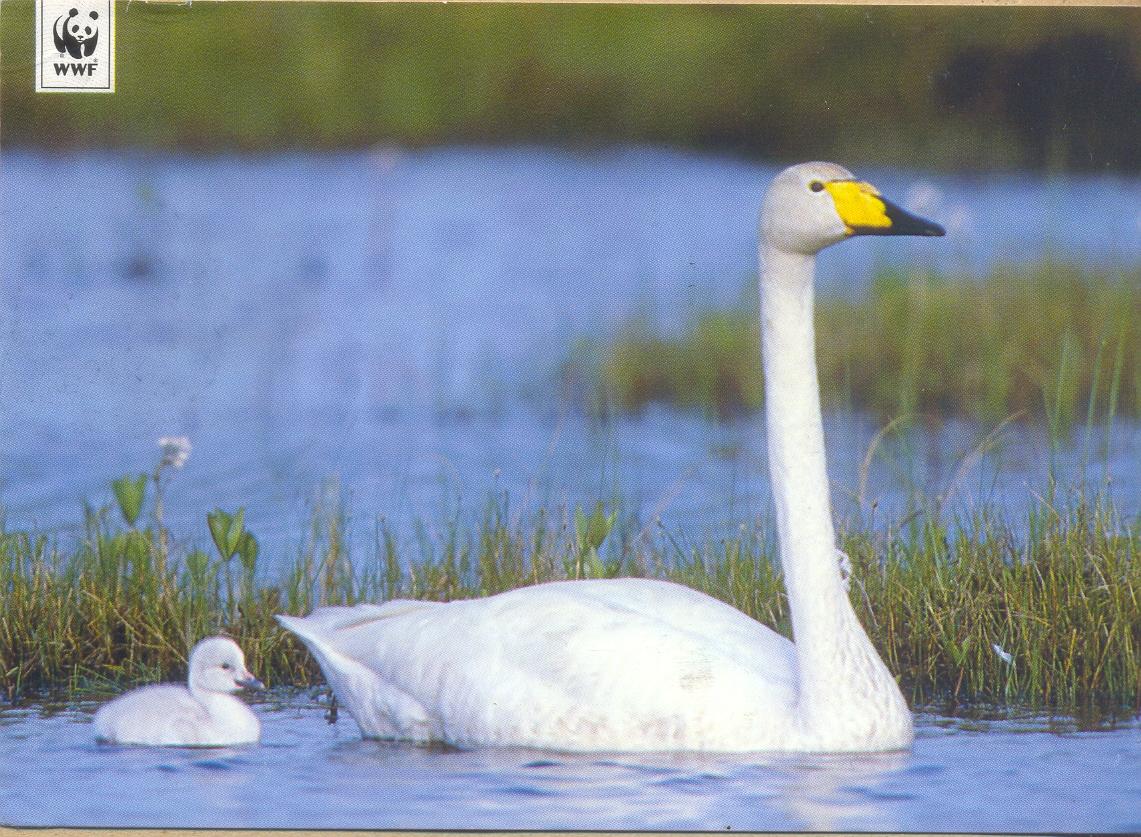
Finland – The Swan


Swans, genus Cygnus, are birds of the family Anatidae, which also includes geese and ducks. Swans are grouped with the closely related geese in the subfamily Anserinae where they form the tribe Cygnini. Sometimes, they are considered a distinct subfamily, Cygninae. There are six to seven species of swan in the genus Cygnus; in addition there is another species known as the Coscoroba Swan, although this species is no longer considered related to the true swans. Swans usually mate for life, though 'divorce' does sometimes occur, particularly following nesting failure. The number of eggs in each clutch ranges from three to eight.

In the Finnish epic Kalevala, a swan lives in the Tuoni river located in Tuonela, the underworld realm of the dead. According to the story, whoever killed a swan would perish as well. Jean Sibelius composed the Lemminkäinen Suite based on Kalevala, with the second piece entitled Swan of Tuonela (Tuonelan joutsen). Today, five flying swans are the symbol of the Nordic Countries and the whooper swan (Cygnus cygnus) is the national bird of Finland.

And everyone knows of Swan Lake a very famous ballet and its music is easily recognizable. This lovely card was sent to me by Ella.

Saturday, July 23, 2011

Germany – SS Kaiser Wilhelm der Grosse


There is no doubt that the Kaiser realised what great national symbols large ships would be for his empire. He returned to Germany with the intention of building German liners to show the world the capability of the German Empire. And what would be a better way to do this, than to capture the famous Blue Riband into German hands? But it would take them some years to do so.
In Germany, there were two major transatlantic shipping companies: The Hamburg-Amerika Line and the Norddeutscher Lloyd (North German Lloyd). Neither of these lines had up until now shown any interest in operating large liners. But the steadily growing immigration traffic and the wishes of the Kaiser soon changed their minds.
Norddeutscher Lloyd was the company that took the first step. The Kaiser wanted Germany's ships to be the greatest ever, and he wanted German shipbuilders to build them. Norddeutscher Lloyd therefore approached the Vulcan Shipyards at Stettin. With them they placed the order for what would become the very first German superliner.
On May 4th 1897, the new ship was ready for its launch. The Kaiser himself was present, and the ship was named Kaiser Wilhelm der Grosse after his grandfather. The new ship would set a new style for ocean liners. She was the largest and longest liner afloat. She would have been the biggest ever had it not been for the Great Eastern of 1860. The most striking feature of the Kaiser Wilhelm der Grosse was her four funnels, the first ship ever to sport such a quartet that for the next decade would be the symbol of size and safety. To give her record-breaking speed, the ship was fitted with reciprocating engines capable of developing some 31,000 horsepower.
But the thing that was really ground-breaking was the fashion of her interior design. For the first time in history, one single designer was responsible for the decorating of an entire ship. On the Kaiser Wilhelm der Grosse, as well as on her three subsequent sisters, the designer's name was Johannes Poppe. His style of interiors was of a new kind, and it would be reflected in many German liners to come. Favouring baroque revival, Poppe created an atmosphere that had no match in decoration. Public rooms were given high ceilings and rich ornate carvings. His taste for grandiosity seemed to know no limits, and it was almost as if he had tried to gild the whole ship. Nevertheless, the travelling public enjoyed the new Kaiser, and she quickly became a very popular ship.
As with the Kaiser's ideal Teutonic, the Kaiser Wilhelm der Grosse had been built with a possible war in mind. Should it ever be necessary, the ship could be fitted with guns to serve as an auxiliary cruiser.