
Thursday, March 10, 2011
Netherlands – Amersfoort

Wednesday, March 09, 2011
Germany - The only lighthouse with fog bell.

Pingelturm Lighthouse at the mouth of the Weser in Lower Saxony Bremerhaven is a seaport. As such, its external appearance is naturally characterized by lighthouses. The most northerly lighthouse is located to the south of the entrance to the Caesar`s Lock which leads to the Caesar`s Harbor and Connection Harbor. This is the beacon "Caesar`s Lock East light ”, in the vernacular called "Pingelturm”. Its architecture is very attractive and the beacon is a veritable unique specimen with its external fog bell. Incidentally, the bell still operates when it is foggy. Then it rings four times in rapid succession. The lighthouse is simply unmistakable in its entire appearance. The red brick building with a height of approximately 15 m, dating from the year 1900 and conceived by the harbour architect Rudloff, is easily recognizable from afar at the dyke.
It is a tapered round brick tower with lantern and gallery, the lantern crowned with a spike like that of an Imperial Army helmet. Lighthouse unpainted red brick with white false window casings; the lantern is green. The original fog bell, still active (4 strokes every 10 s), is mounted on the side of the tower. The elegant turn-of-the-century architecture of this lighthouse makes it a unique historic treasure. The light guides ships into the Kaiserhafen, a protected harbor in downtown Bremerhaven entered through a lock, the Kaiserschleuse. The familiar sound of the fog bell has given the lighthouse the local nicknames of Klingelturm or Pingelturm. Located on the east side of the harbor entrance, on the north side of downtown Bremerhaven. This nice card was sent to me by Ina from Germany.Tuesday, March 08, 2011
Canada – The Gastown Steam Clock

Monday, March 07, 2011


Saturday, March 05, 2011
Ukraine – Varenyky
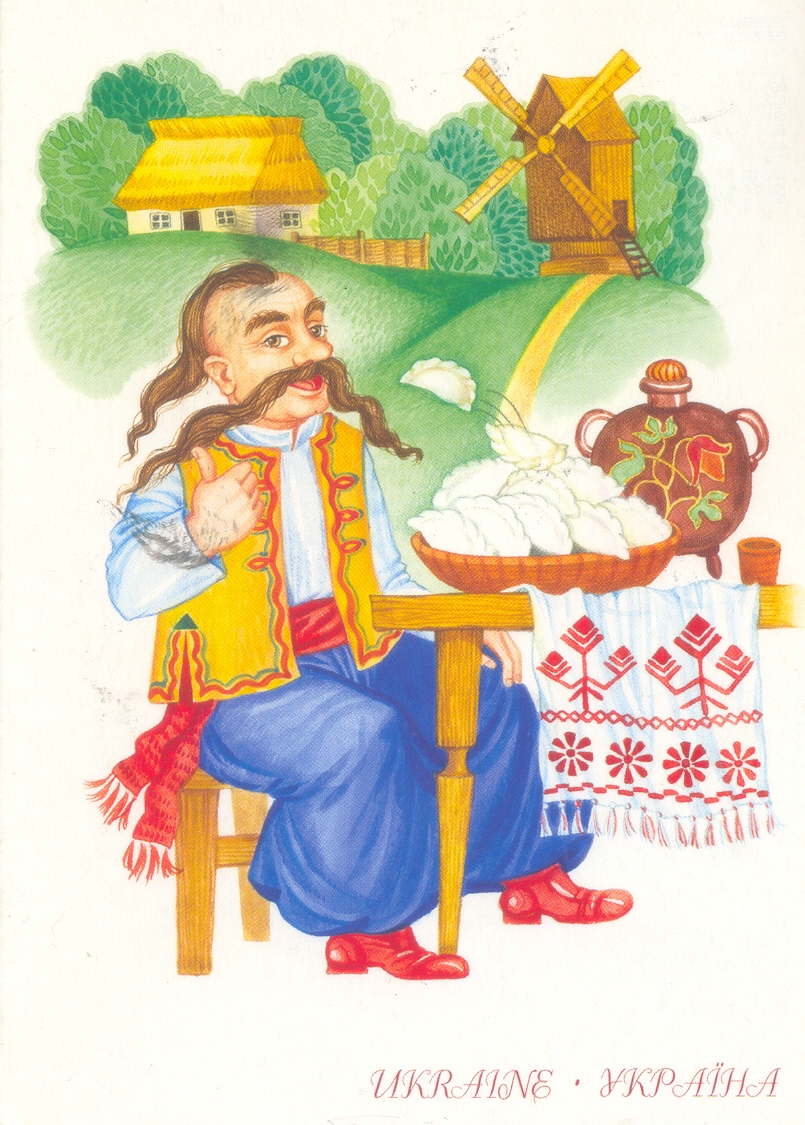
Varenyky or pierogi (Canadian Ukrainian), are a kind of stuffed dumpling associated with Ukrainian cuisine. Some variants are also found in Moldovan, Mennonite, Belarusian, Russian, Lithuanian, and Polish cooking. Varenyky are believed to originate from Chinese and Siberian influences, although sometimes they are said to be of Turkish origin. Varenyky are similar to Polish pierogi. Varenyky are square- or crescent-shaped dumplings of unleavened dough, stuffed with sauerkraut, cheese, mashed potatoes, cabbage, meat, hard-boiled eggs (a Mennonite tradition) or a combination of these, or with a fruit filling. Varenyky are very popular in Ukraine. This attractive card was sent to me by Roma.
Friday, March 04, 2011
China – Jinan University

Jinan University is a leading research and comprehensive university based in Guangzhou, Guangdong province, China. It is one of the oldest universities established on mainland China tracing back to the Qing Empire. It is a university administered by the Overseas Chinese Affairs Office of the State Council and the Chinese Ministry of Education. The name "Ji-Nan" (also Chi-Nan "reaching southward") comes from 'The Classic of History' which is a compilation of documentary records related to events in ancient history of China. The articles reads, "His speech and teachings spread from north to south, until they reached the four corners of the world." Thus the name "Jinan" conveys the school's mission: to spread Chinese culture and learning from North to South, from China to the rest of the world. Gong Yudie sent me this nice maxi card
Thursday, March 03, 2011
Cyprus – Gourri Village

Merja wanted me to see this quaint village of Gourri in the Troodos Area. It is a populated place in Nicosia, Cyprus. The name comes from a medieval aristocratic family called Gourri. Their coat of arms, a sun displayed, is found in several places in the island. One of the members of the family was Jacques du Gourri, viconte of Cyprus. The Church is dedicated to Saint George and it was built in 1775.
Subscribe to:
Posts (Atom)